Medical Disclaimer
This article is for educational purposes only and does not replace medical advice. Modafinil is a prescription medicine in Canada, and whether it is appropriate for an individual requires professional assessment. Anyone with questions about Modafinil, personal health, other medicines, possible interactions, or side effects should consult an appropriate healthcare professional or pharmacist.
Researching modafinil canada can quickly lead to several different kinds of information. Canadian readers may encounter medical descriptions of Modafinil, prescription and regulatory questions, discussions about wakefulness and productivity, international product names, online sellers, personal testimonials, and claims about cognitive enhancement—all within the same search.
However, those sources do not necessarily answer the same question or carry the same weight. A medicine being discussed or offered online does not establish its Canadian authorization status. Likewise, a personal account does not show what will happen to another person. A product name such as Modalert or Modvigil should not be confused with the active ingredient itself or assumed to have the same regulatory status in every country.
This guide brings those distinctions together. It explains what Modafinil is, where it fits medically, why Canadian regulation matters, how it differs from Armodafinil and everyday caffeine, what readers should know about safety, and how to assess the different types of information encountered when researching Modafinil online.
Modafinil in Canada at a Glance: Start With the Medicine, Not the Marketing
Modafinil is a prescription wakefulness-promoting medicine. That description provides a more accurate starting point than common online labels such as “smart drug,” “study drug,” or “productivity enhancer.”
Its clinical role relates to promoting wakefulness in specific medical circumstances. However, that is different from promising that a healthy person will become more intelligent, learn faster, perform better at work, or need less sleep.
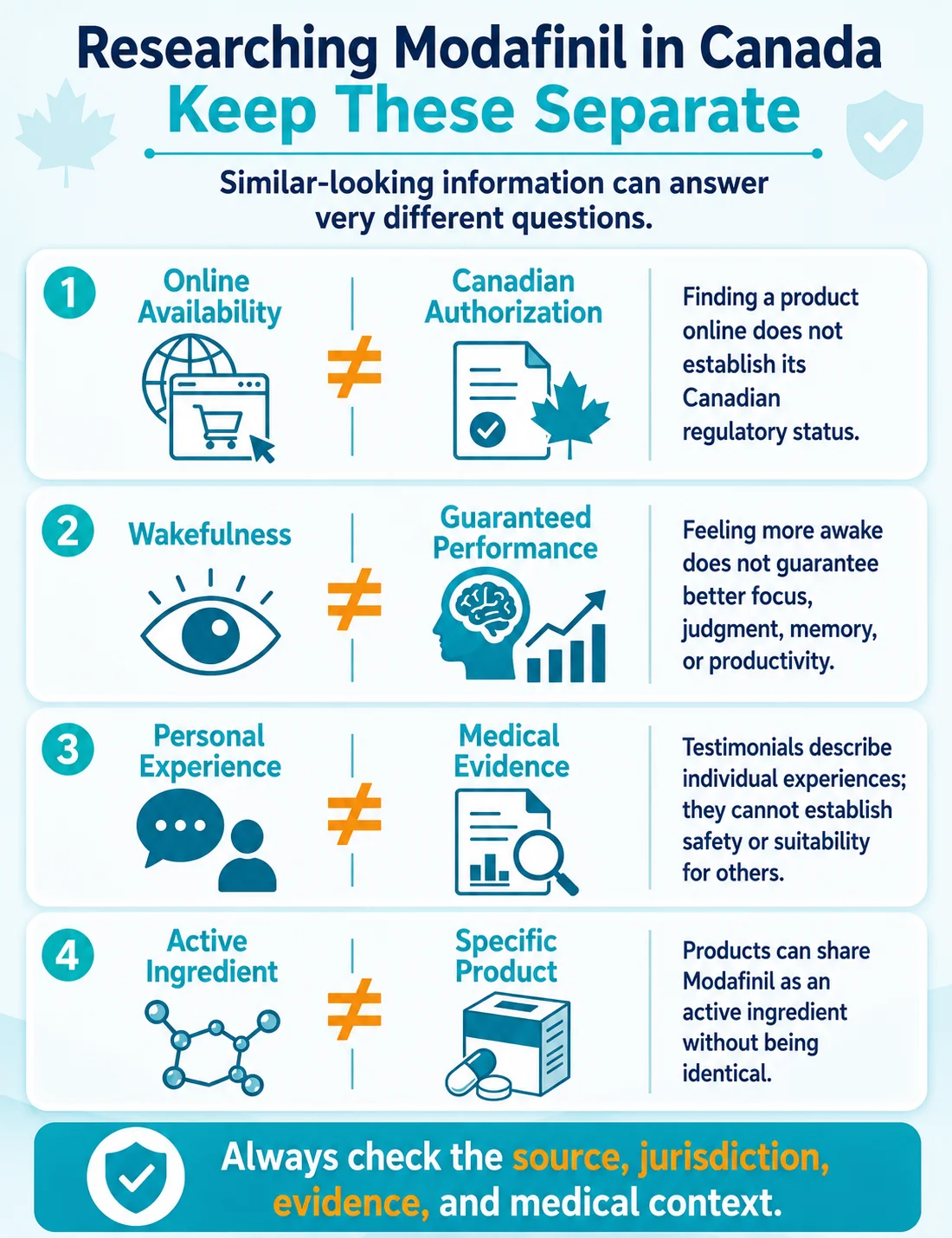
Canadian Modafinil research becomes easier when readers keep several concepts separate from the beginning:
- Modafinil refers to an active pharmaceutical ingredient, not every product name associated with it.
- Its established medical context concerns wakefulness, not guaranteed cognitive enhancement.
- In Canada, Modafinil belongs within a prescription-medicine context, so professional assessment matters when deciding whether it is suitable for an individual.
- Products, brands, and manufacturers encountered internationally may not share the same Canadian regulatory status.
- Online availability shows that something is being advertised or offered; it does not by itself establish authorization, authenticity, quality, or medical suitability.
- Personal experiences can raise useful questions, but they cannot replace clinical evidence.
Together, these distinctions provide the foundation for evaluating almost every other question about modafinil canada.
Why the Modafinil Canada Context Matters
Much of the information visible to Canadians online comes from international sources. Search results can mix Canadian healthcare information with overseas product pages, foreign pharmacy practices, research papers, discussion forums, and websites written under entirely different regulatory systems.
Therefore, geography is more than a minor detail.
For Canadian readers, questions about a prescription medicine need to be considered within the Canadian healthcare and regulatory environment. Health Canada resources, Canadian product information, healthcare professionals, and pharmacists provide different kinds of information from international commercial websites.
For example, a manufacturer may market a product under a particular brand in another country. Its presence on an international website does not automatically mean that the same product has Canadian authorization. Similarly, statements about obtaining a medicine in another jurisdiction do not necessarily describe Canadian requirements.
Readers who want a deeper overview of prescription and regulatory issues can review the dedicated guide to Modafinil’s legal and regulatory context in Canada.
This distinction becomes especially important when someone searches broad phrases such as “Modafinil online” and receives results that do not clearly identify which country’s rules they describe.
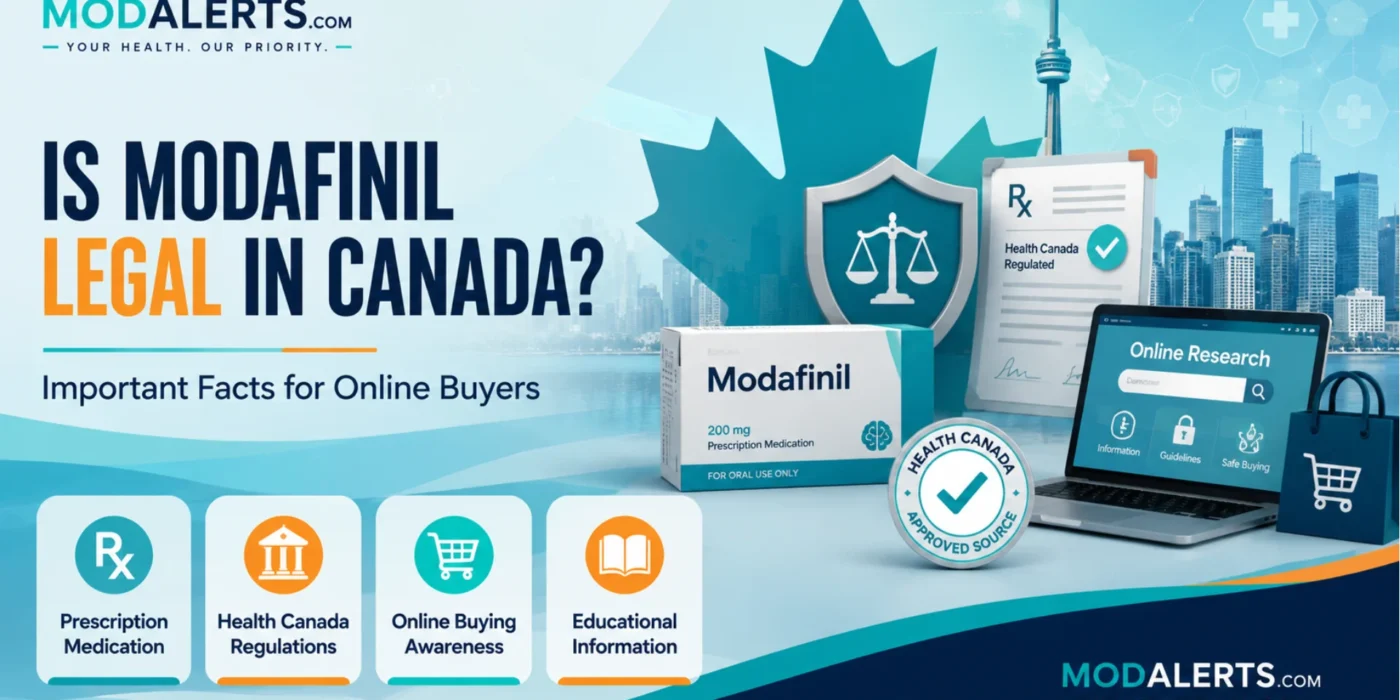
Modafinil Prescription Status, Authorization, and Availability in Canada
Three concepts frequently become blurred.
Prescription status concerns how a medicine is regulated and supplied within the Canadian healthcare system.
Product authorization concerns whether a specific drug product has authorization for sale within the relevant Canadian regulatory framework.
Online availability simply describes whether a website appears to offer a product.
These concepts are not interchangeable. Seeing a medicine advertised online does not answer whether a particular product has Canadian authorization, whether a transaction meets applicable requirements, or whether that product is medically appropriate for a particular person.
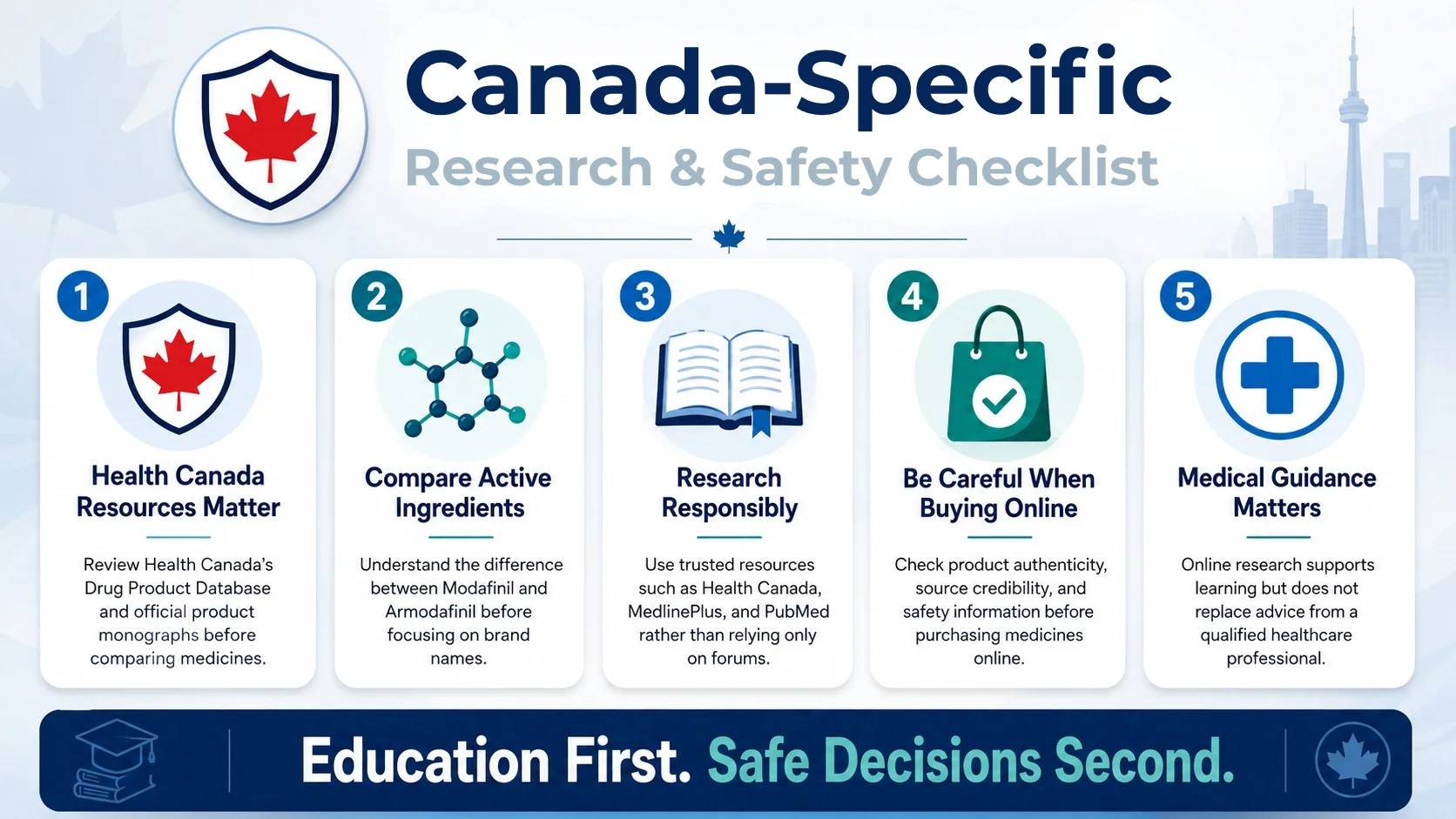
For product-specific regulatory research, Health Canada’s Drug Product Database provides an official starting point for information about drug products authorized for sale in Canada.
Importation is another distinct issue. General statements found on forums or international commercial pages may omit important conditions or may become outdated. Health Canada’s personal-use health-product importation guidance is therefore a more appropriate source when researching the federal framework.
Importantly, a general educational article cannot determine whether a specific transaction, shipment, product, or personal situation complies with current requirements. Those questions depend on the relevant facts and current rules.
A Practical Hierarchy for Canadian Modafinil Research
Different questions require different sources. The following table helps separate them.
Research question | What the information can establish | Appropriate place to verify |
What is Modafinil? | Active ingredient, pharmacological, and medical context | Reliable medical or drug information |
What medical role does it have? | Evidence-based clinical uses and limitations | Canadian product information and healthcare professionals |
Is a specific product authorized in Canada? | Canadian regulatory status of that product | Current Health Canada information |
Is it advertised online? | Commercial availability on a particular website | The website itself—but availability does not establish authorization |
Is Modafinil suitable for me? | An individual clinical decision | Qualified healthcare professional |
Could it interact with my medicines? | Individual medication-safety considerations | Prescriber or pharmacist |
Did someone online have a good or bad experience? | One person’s reported experience | Testimonial only; not clinical evidence |
Does a seller make strong performance claims? | What the seller claims | Check claims against medical evidence rather than accepting them as proof |
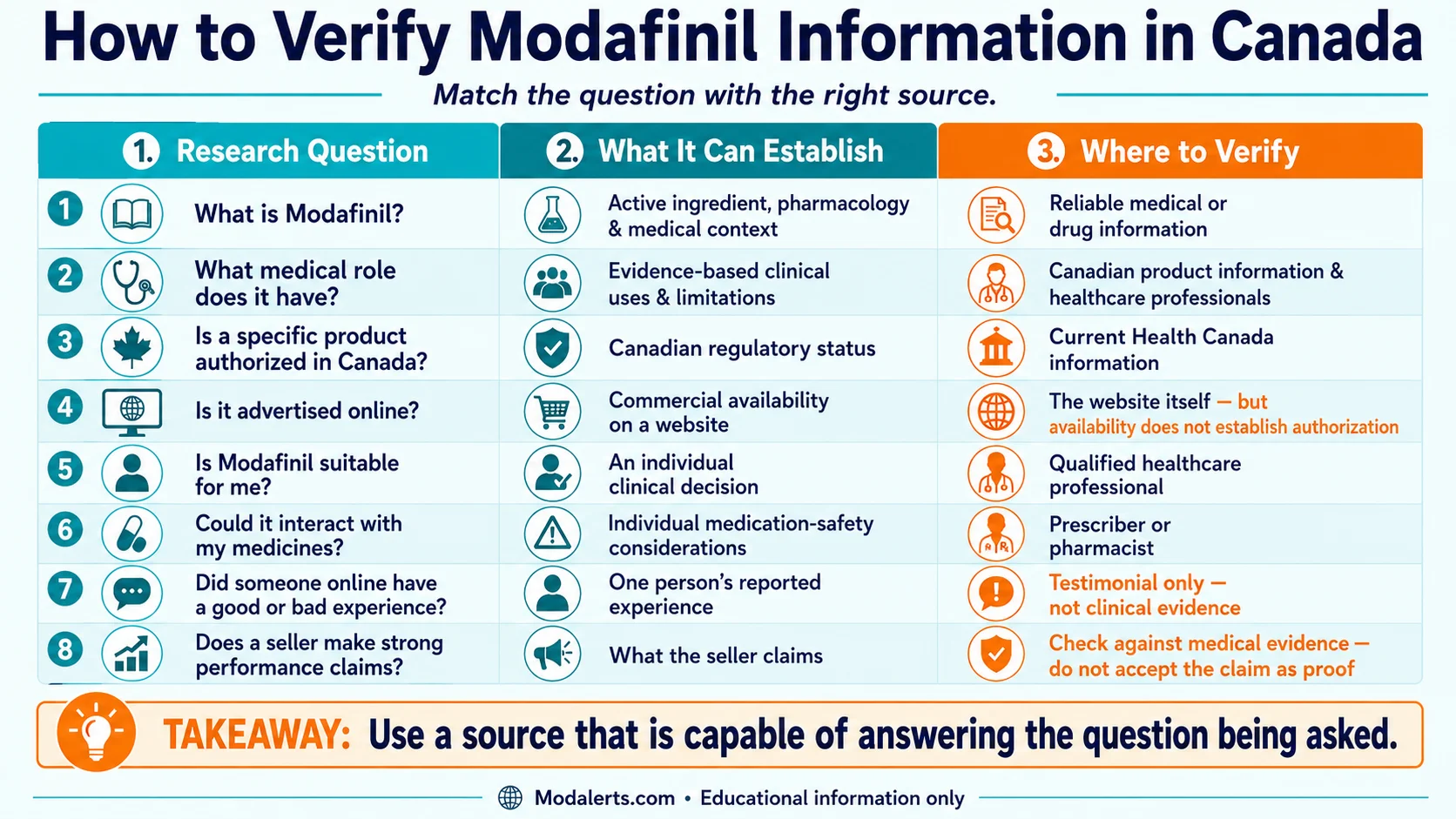
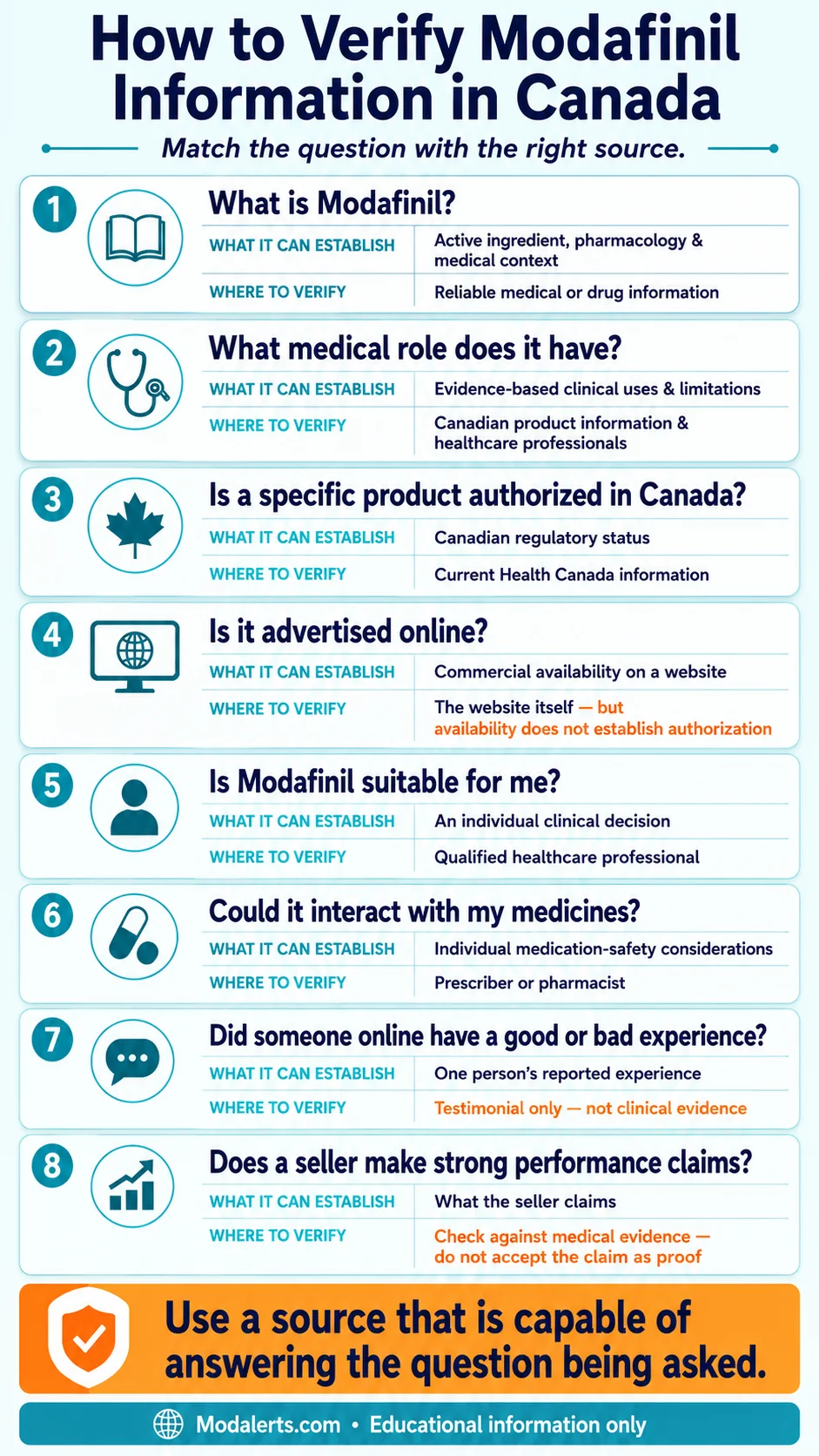
The central lesson is simple: use a source that is capable of answering the question being asked.
Where Modafinil Fits in Canadian Medical Care
Modafinil is best understood through its medical purpose rather than through internet productivity culture. Clinicians use wakefulness-promoting medicines in specific medical contexts involving excessive sleepiness associated with certain sleep-wake disorders.
However, wakefulness-promoting treatment is not the same as treating every possible cause of tiredness. Sleepiness can have many explanations, including insufficient sleep, sleep disorders, medical conditions, medication effects, and lifestyle factors. Therefore, identifying the underlying problem can matter as much as discussing a medicine.
This is one reason individual assessment is important. A person who feels chronically exhausted cannot determine from a general description of Modafinil whether the medicine is appropriate for their circumstances.
In addition, a medicine’s recognized clinical role should not be stretched into a general claim about energy, motivation, intelligence, or productivity. Those concepts may overlap in everyday conversation, but medically they answer different questions.
Modafinil and Shift Work in Canada
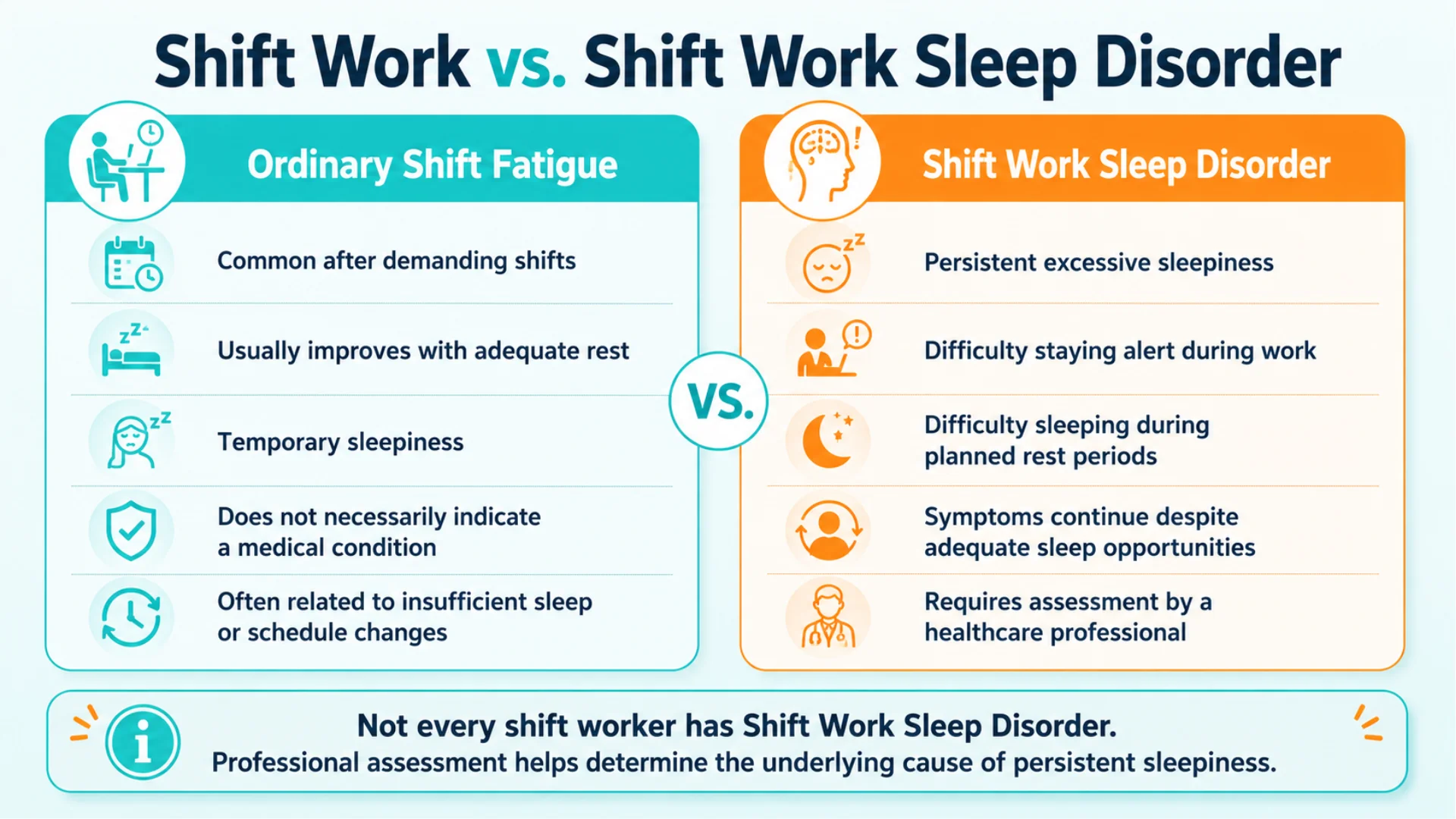
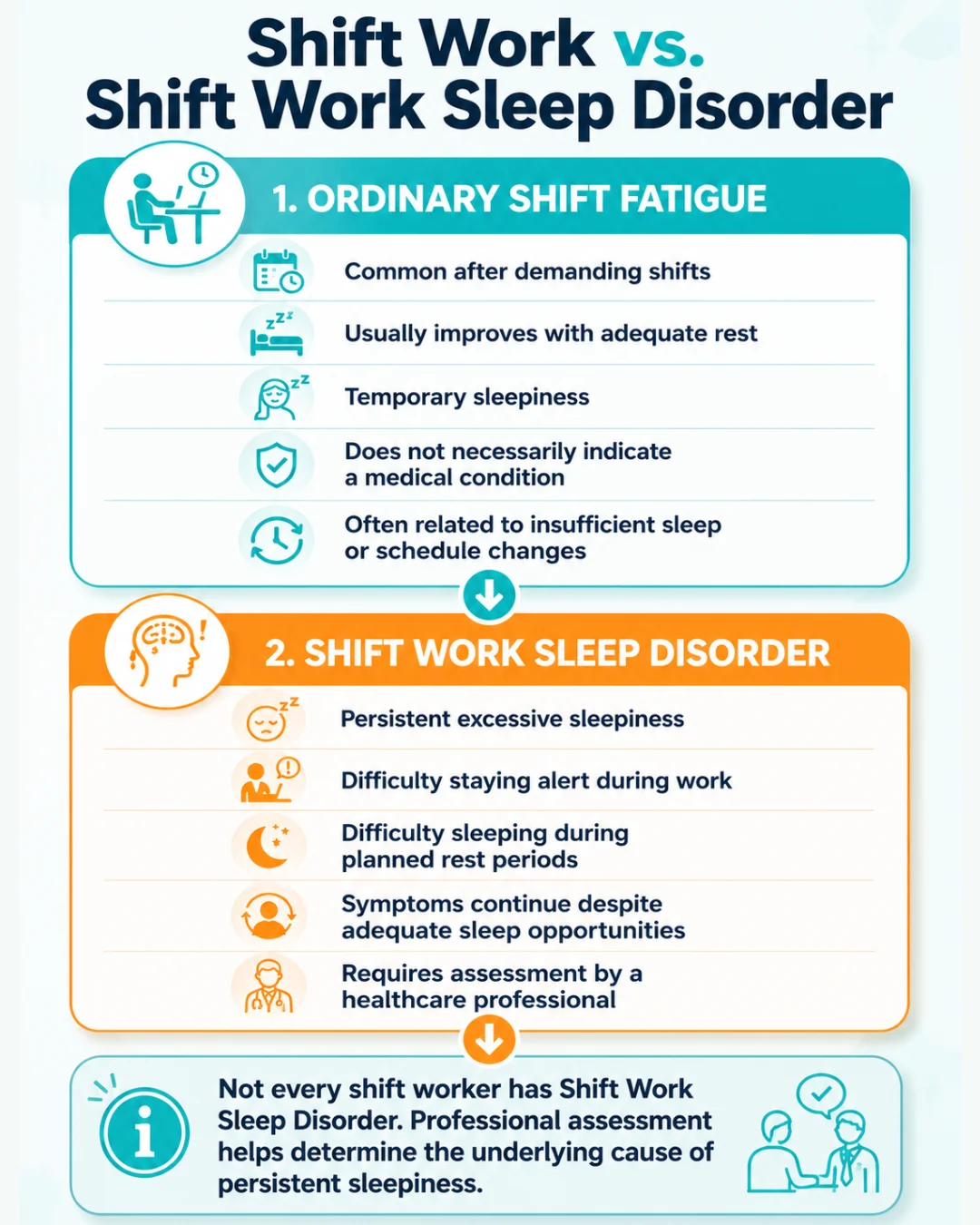
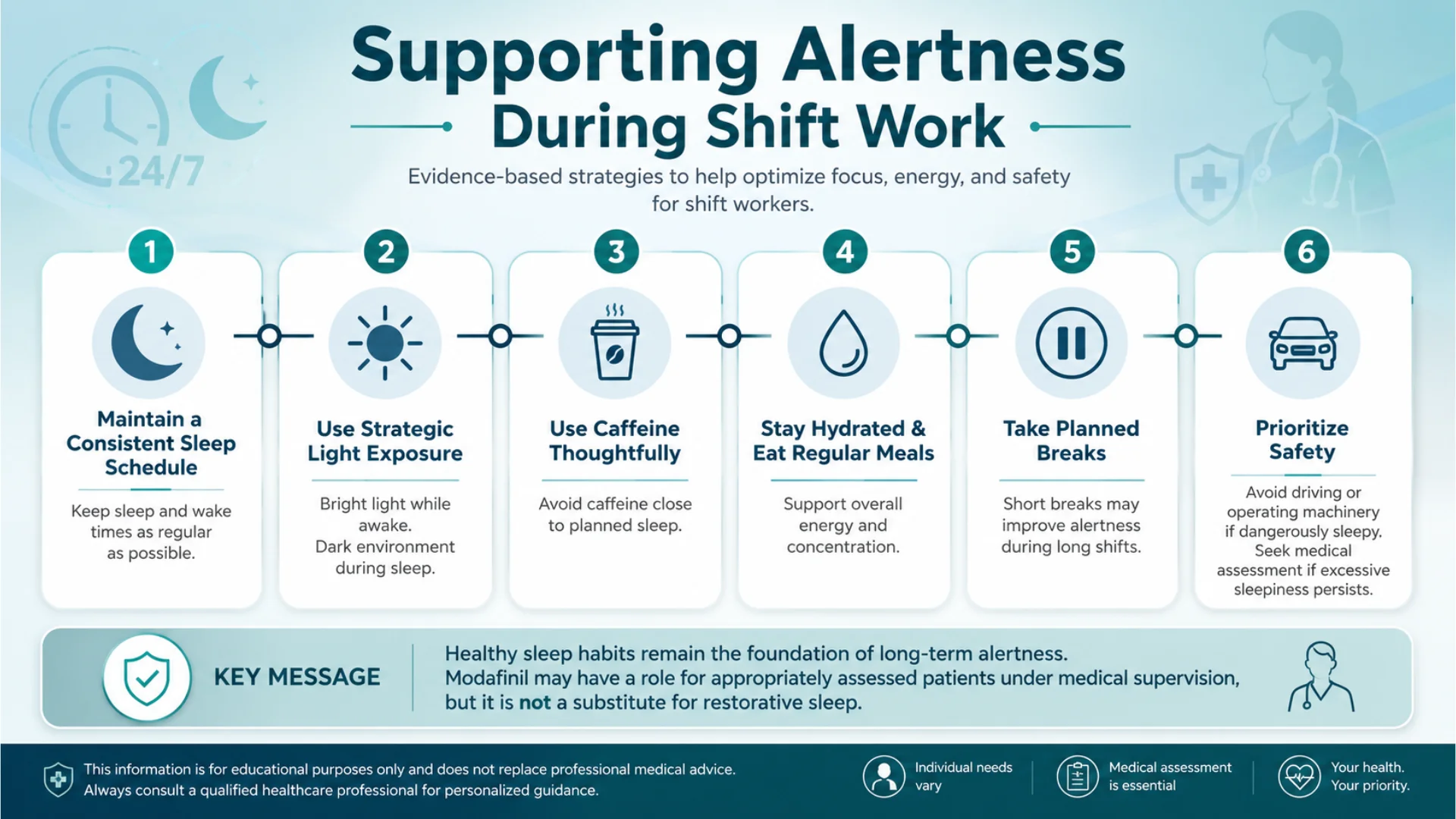
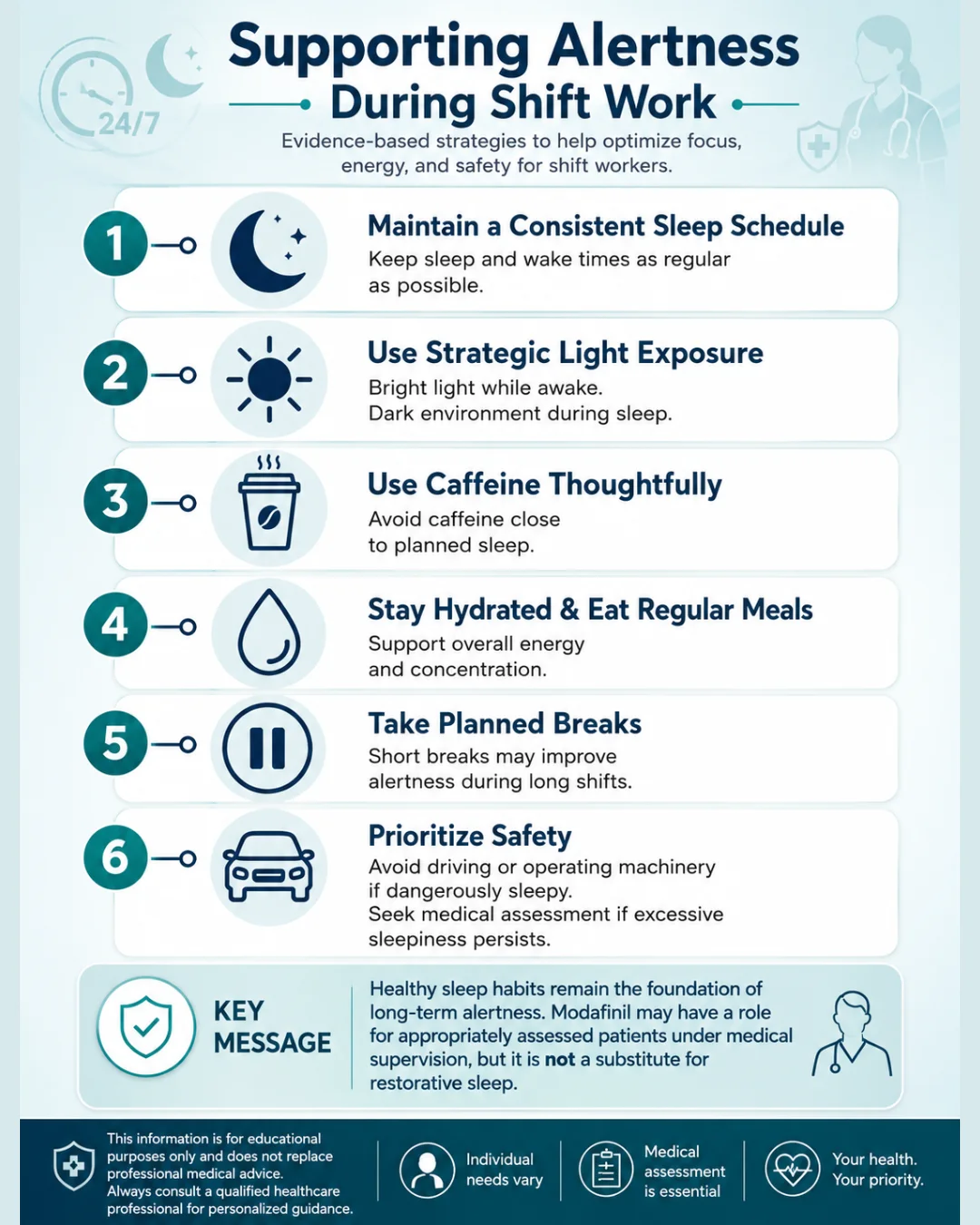
Shift workers frequently encounter discussions of Modafinil because working during normal sleeping hours can create significant challenges involving alertness and sleep timing. In medical contexts, however, the relevant issue is not simply wanting more energy during a long shift.
There is an important difference between ordinary tiredness after inadequate sleep and a clinically assessed sleep-wake problem involving excessive sleepiness.
Consequently, “shift work” should not become a blanket justification for using a prescription medicine. Work schedules, sleep opportunities, symptoms, occupational demands, and health history can all affect how a healthcare professional assesses excessive sleepiness.
The dedicated overview of Modafinil and shift work in Canada examines this distinction in greater detail without treating ordinary workplace fatigue as a diagnosis.
For Canadian workers researching wakefulness medicines, the useful question is therefore not merely, “Will this keep me awake?” It is also, “Why am I excessively sleepy, and what is the appropriate way to address it?”
Key point: promoting wakefulness does not erase the body’s requirement for adequate sleep.
Modafinil, Wakefulness, and Cognitive Enhancement
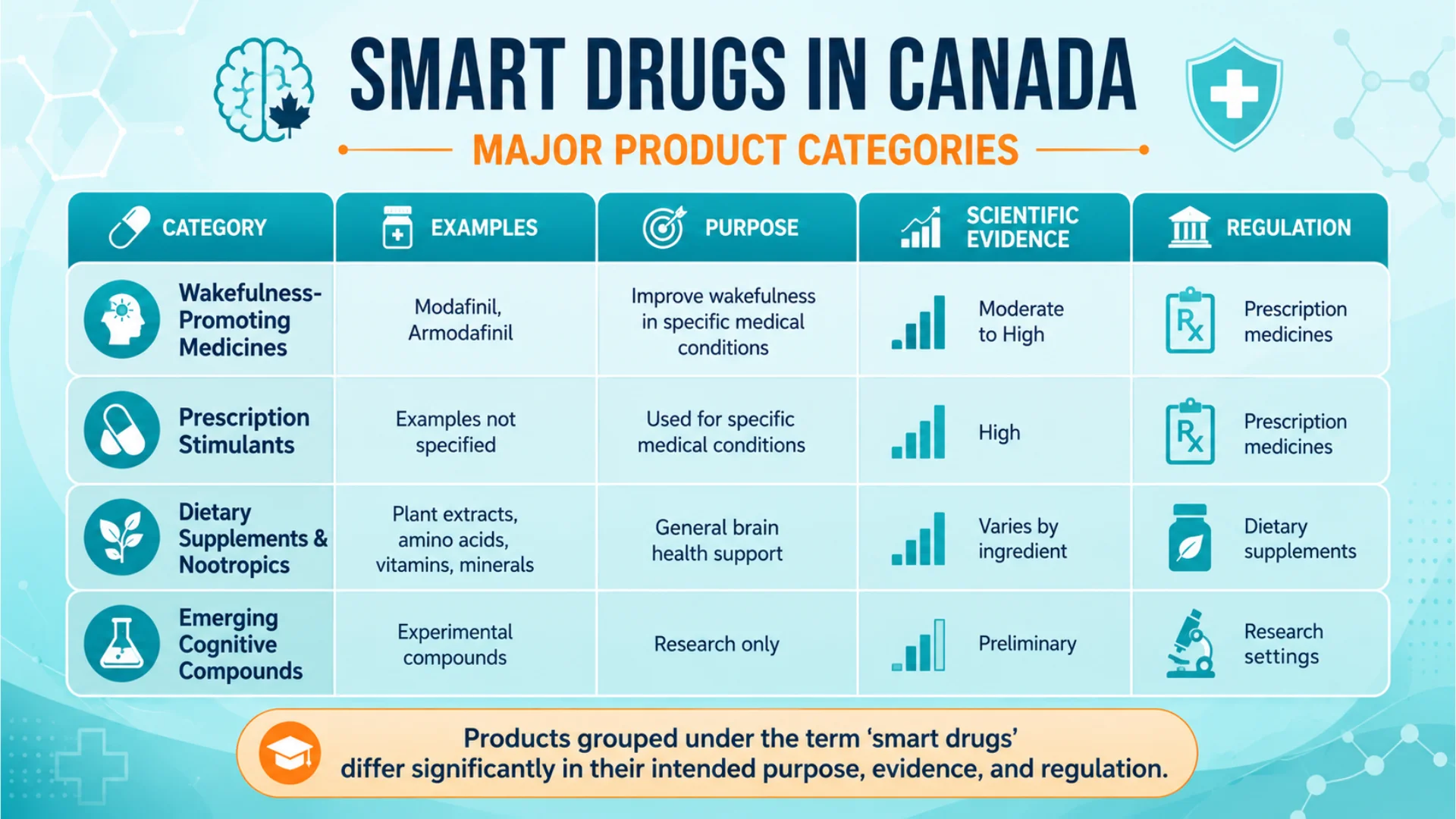
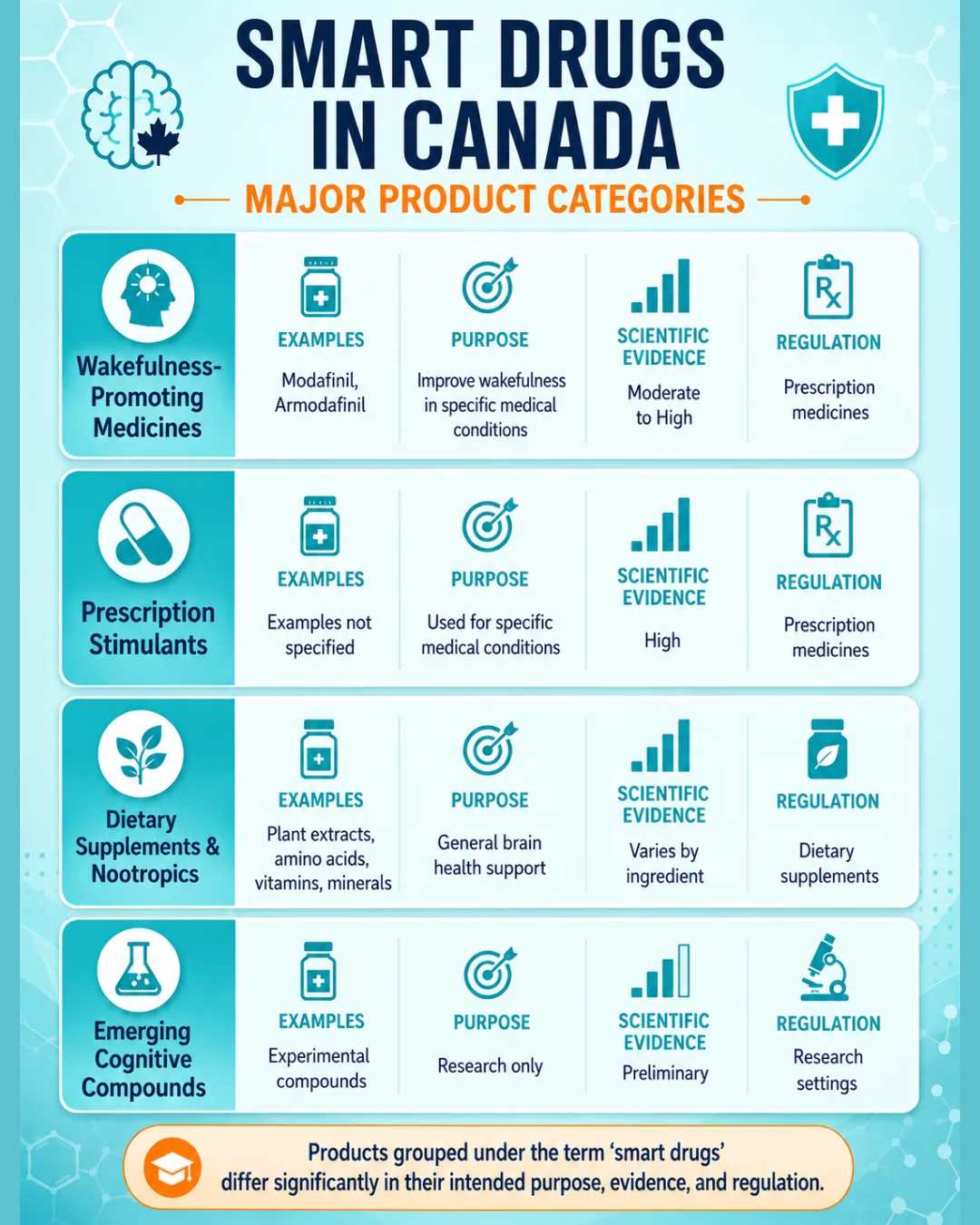
One of the biggest sources of confusion around Modafinil is the language of “smart drugs” and nootropics.
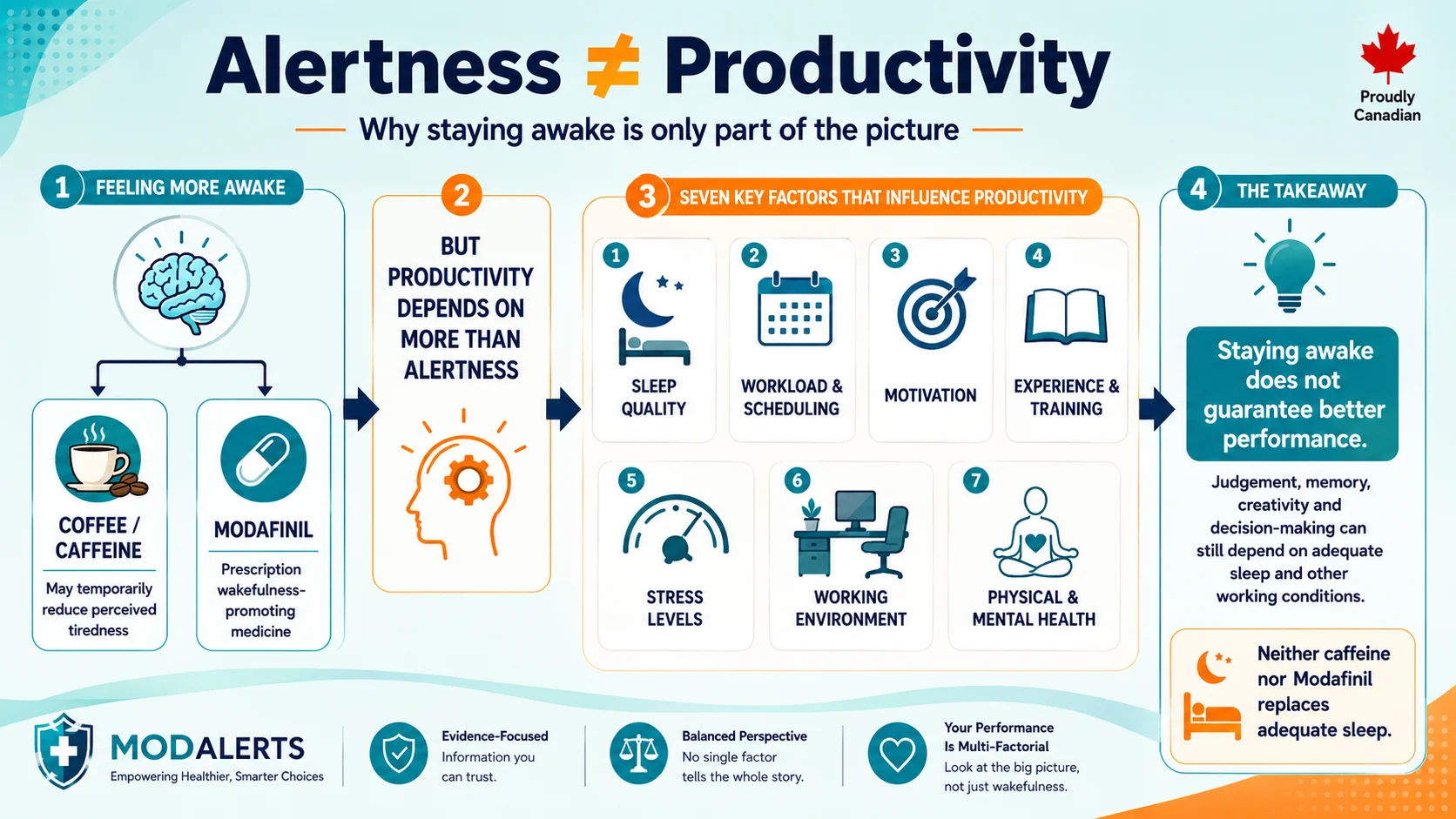
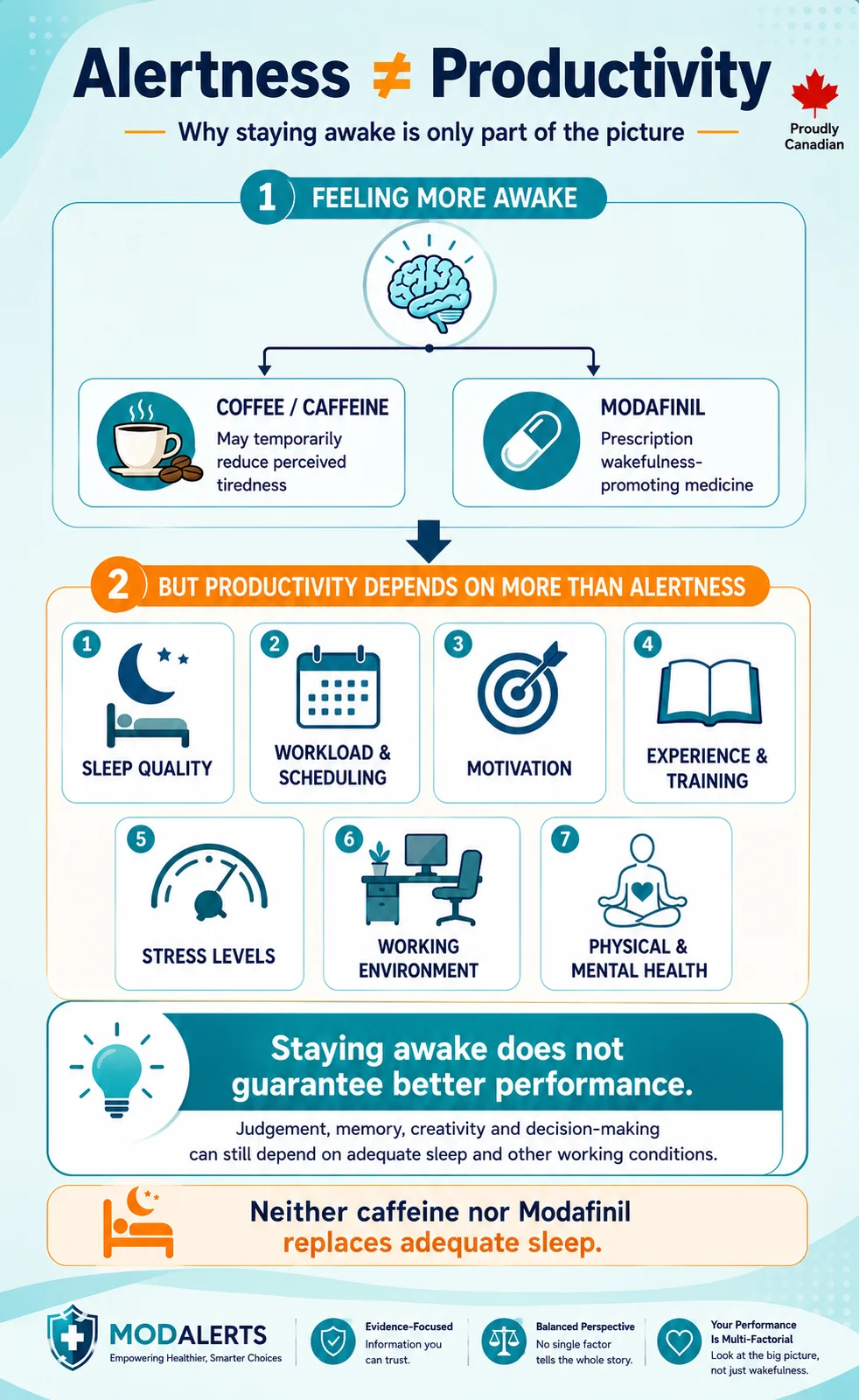
Online discussions sometimes move directly from “helps promote wakefulness” to “improves focus, intelligence, and productivity.” However, those are much broader claims.
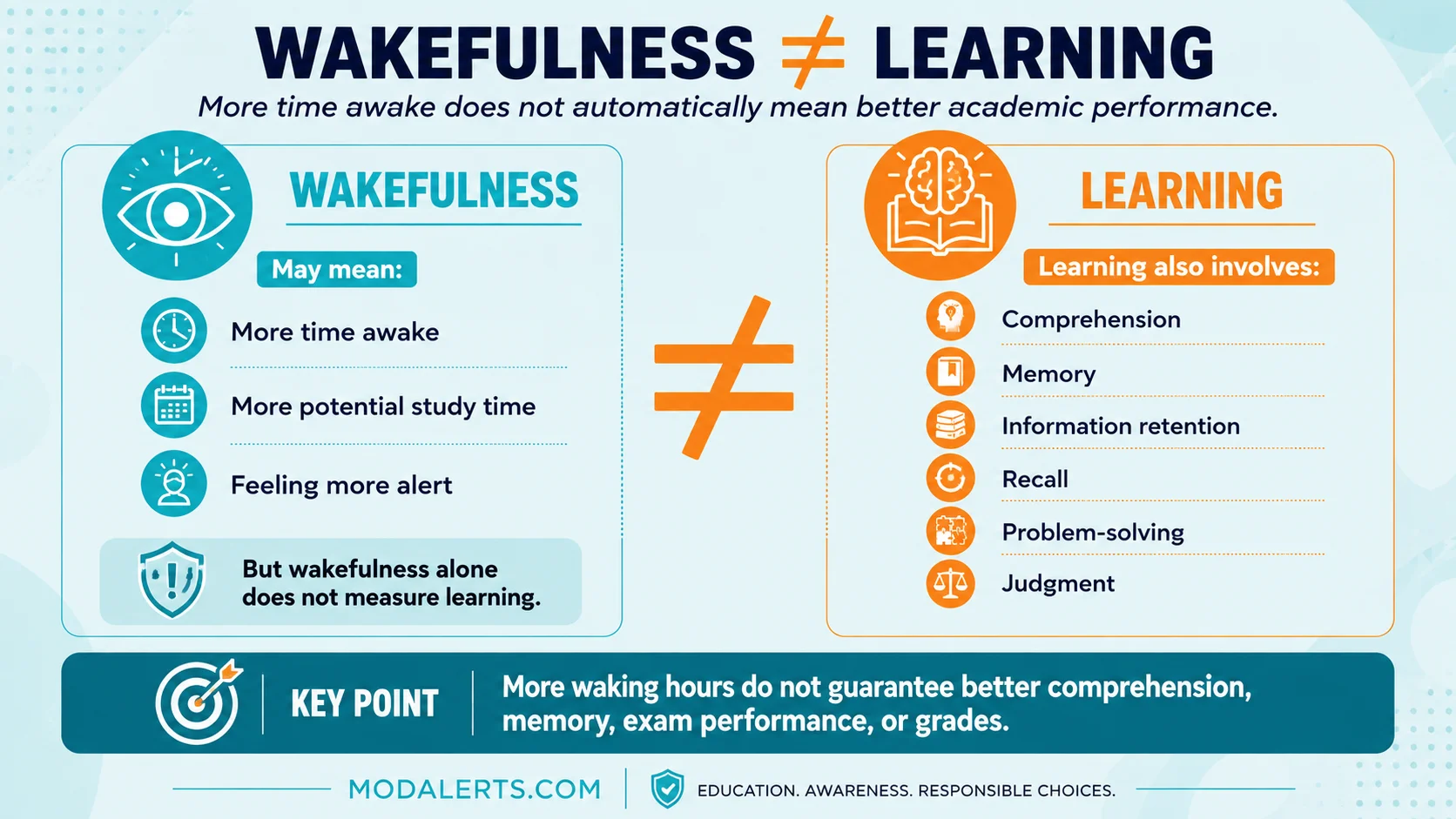
Being more awake can affect how a sleepy person experiences a task. Yet wakefulness is not equivalent to better memory, deeper understanding, sounder judgement, or superior academic and professional performance. Cognitive outcomes are complex and can vary according to the person, task, sleep status, health, and other factors.
Moreover, research into cognitive effects in people without a medical indication is different from evidence supporting a medicine’s established clinical role. Findings from a controlled study cannot automatically become a guarantee of real-world productivity.
Readers exploring the broader nootropic discussion can use the guide to smart drugs and cognitive-enhancement claims in Canada to examine why terms such as “smart drug” often imply more than the evidence establishes.
For modafinil canada research, this distinction is essential: evidence that a medicine promotes wakefulness does not by itself prove that it reliably improves cognition in healthy people.
Modafinil, Students, and Studying in Canada
The distinction is especially relevant to students.
Modafinil is sometimes described online as a “study drug.” However, staying awake for longer does not guarantee that someone will understand difficult material, remember it accurately, or perform better in an examination.
Academic performance depends on learning, memory, sleep, preparation, judgement, and many other variables. In addition, sleep supports cognitive function and memory processes. Treating sleep as an obstacle that a medicine can simply remove creates a misleading framework.
Non-medical academic use also raises safety and prescription considerations that differ from treatment following an appropriate clinical assessment.
The article on Modafinil, students, and study-related claims in Canada explores these issues more closely.
A Canadian student encountering enthusiastic testimonials should therefore separate three questions: Can a medicine promote wakefulness? Has a healthcare professional determined that it is medically appropriate for that person? Do claims of academic enhancement have suitable supporting evidence?
Those questions are not interchangeable.
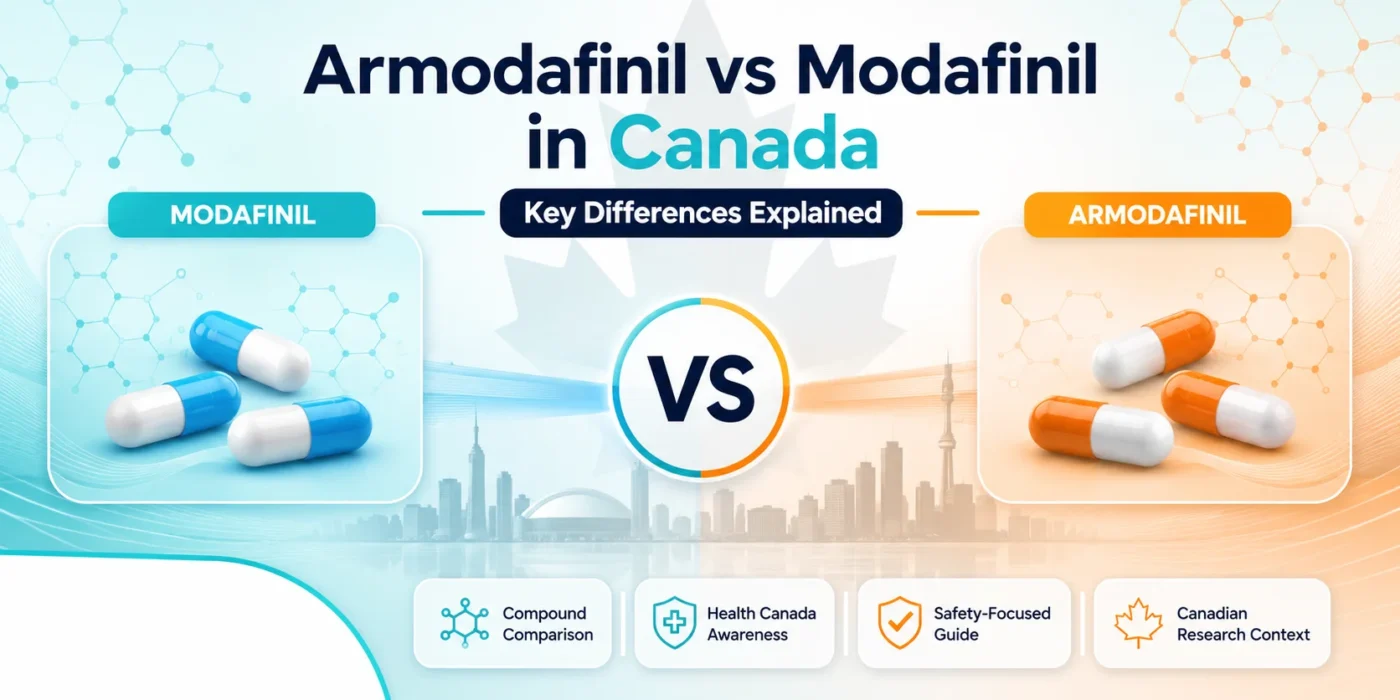
Modafinil vs Armodafinil in Canada: Related, but Not Identical
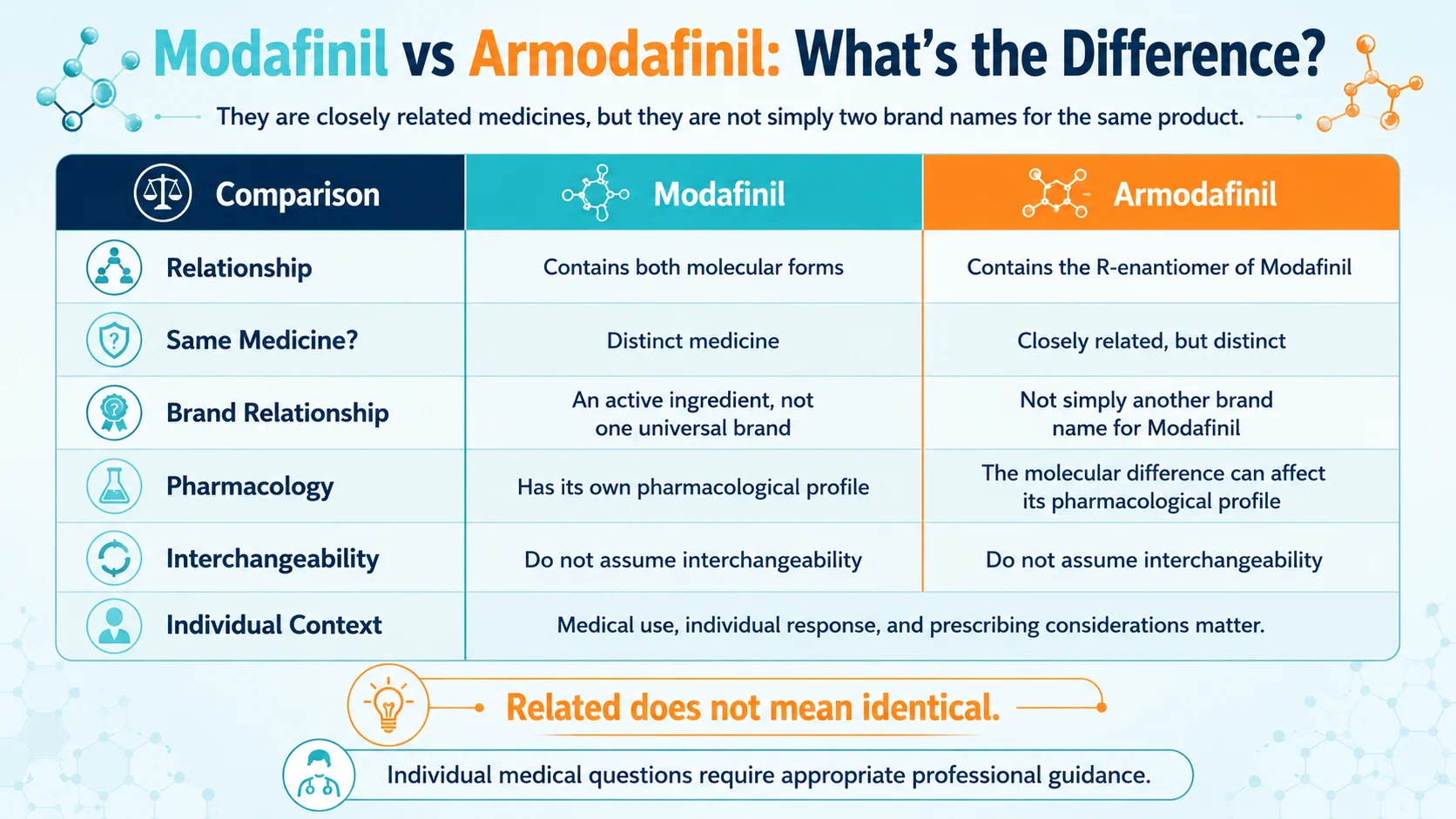
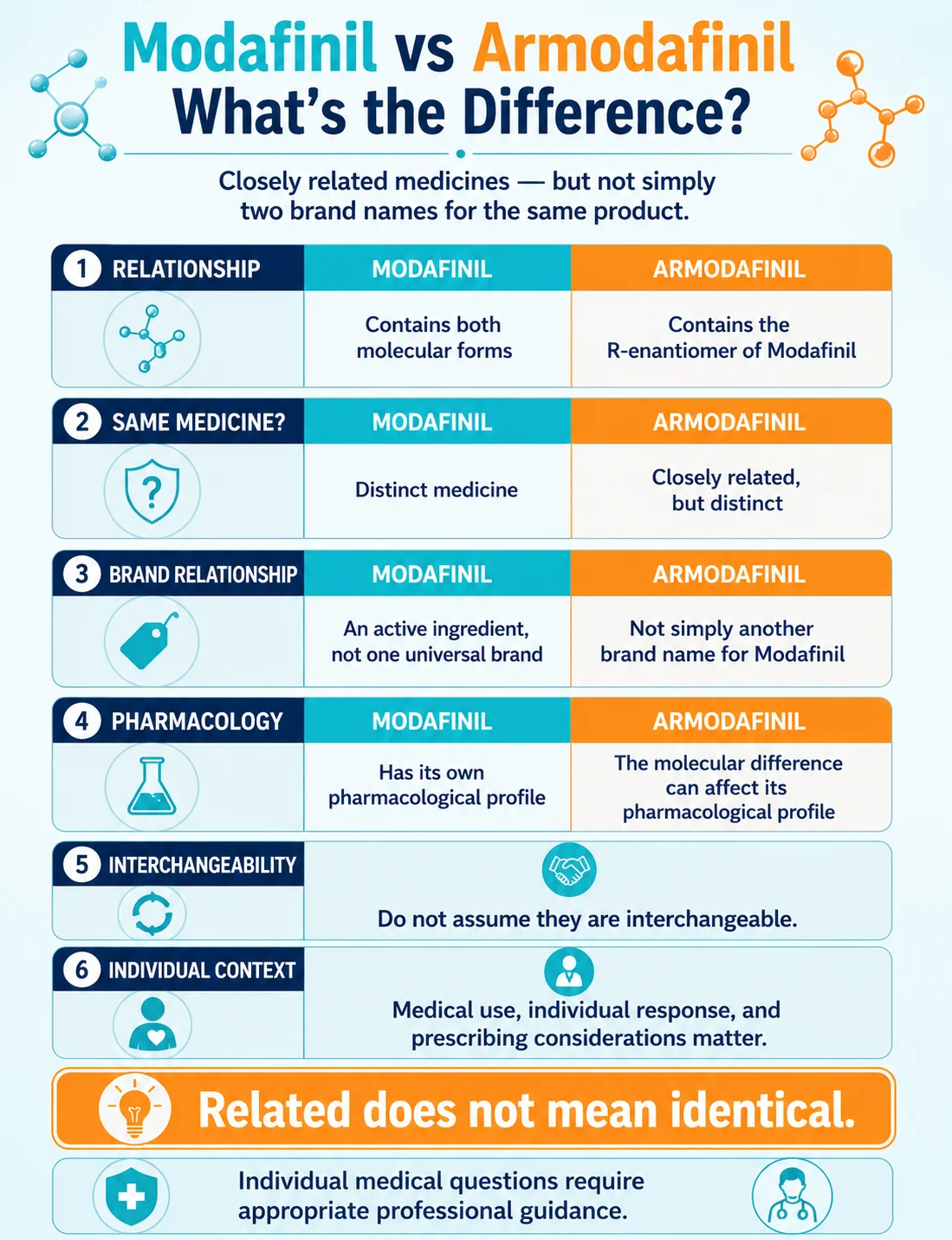
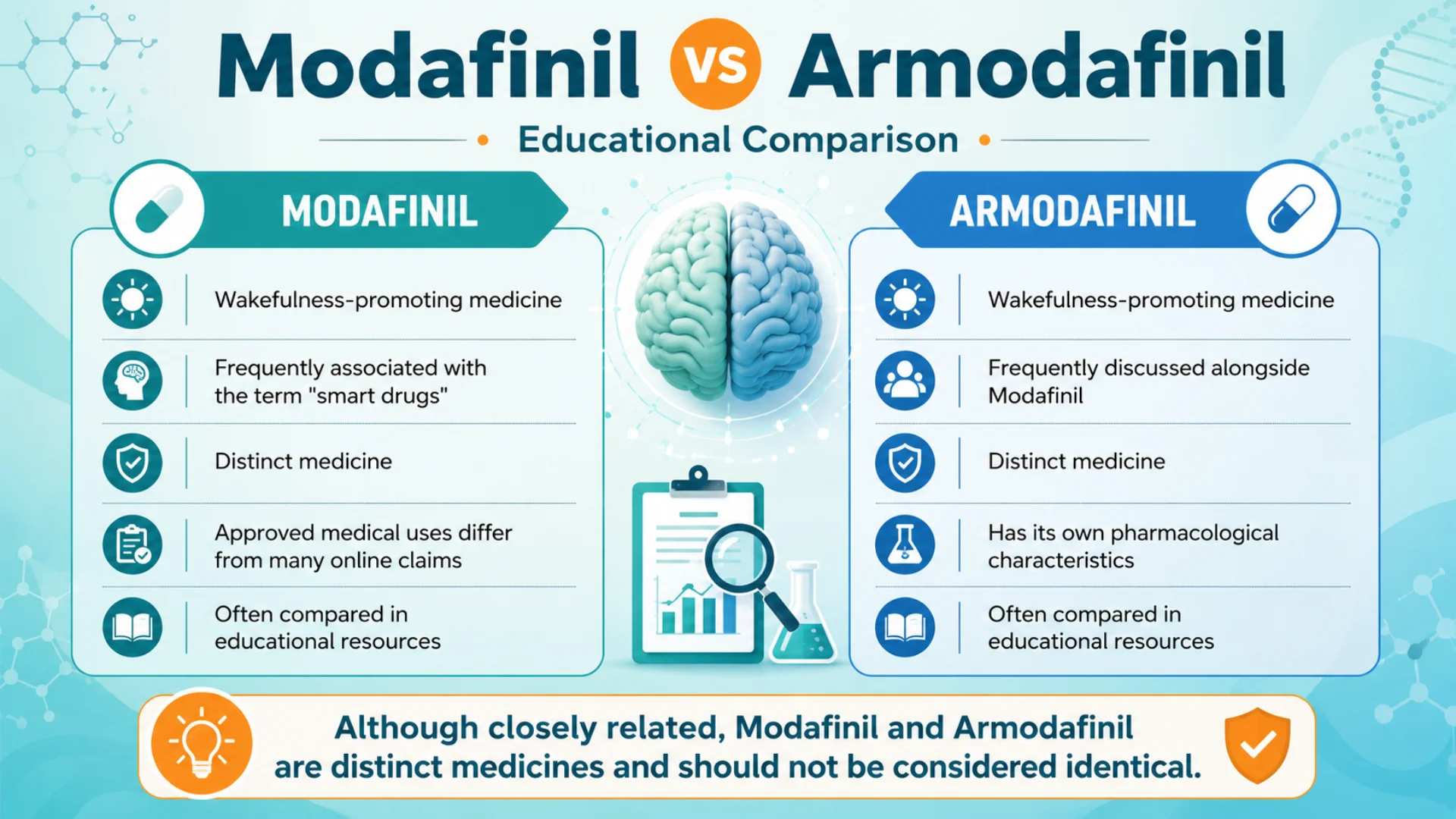
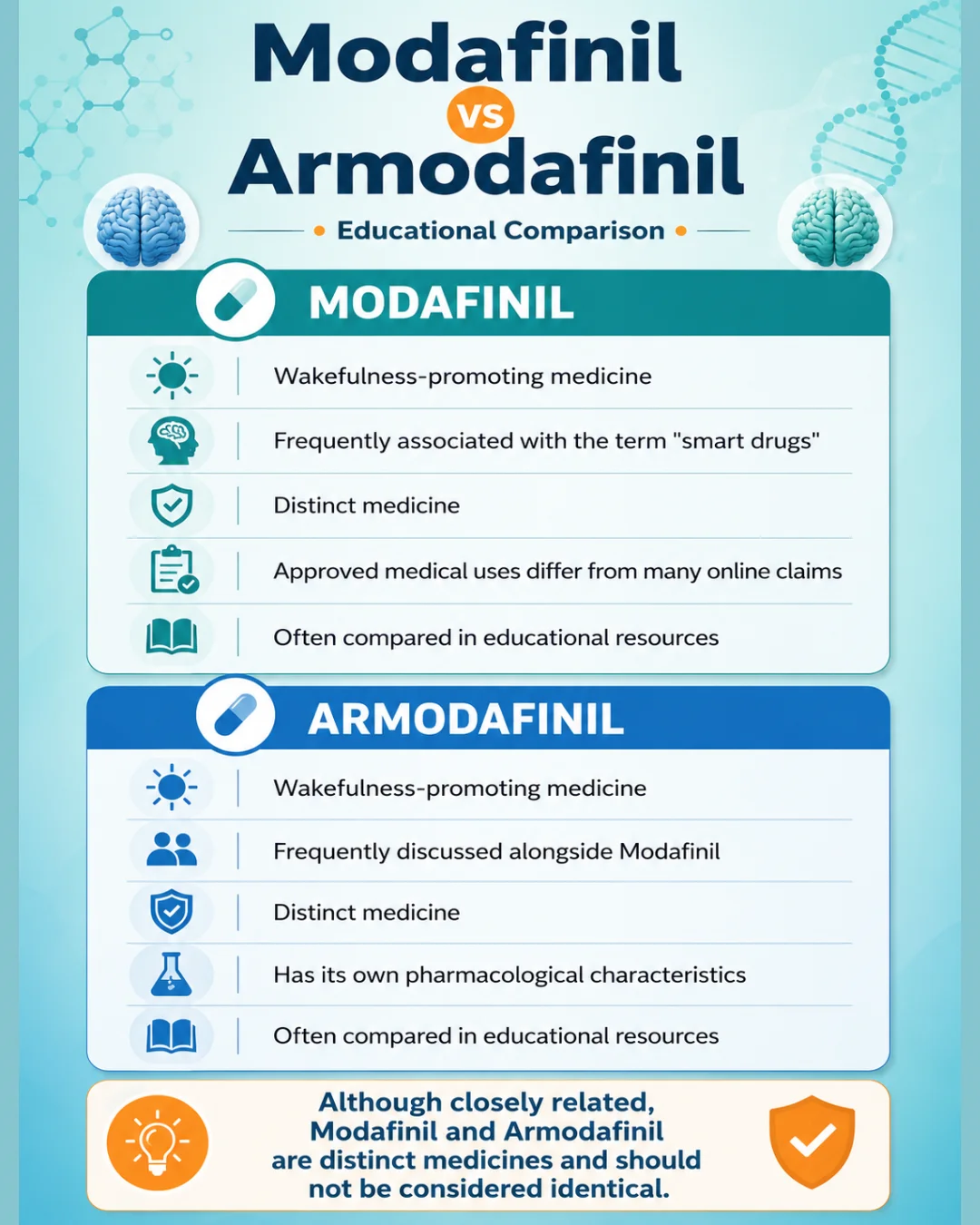
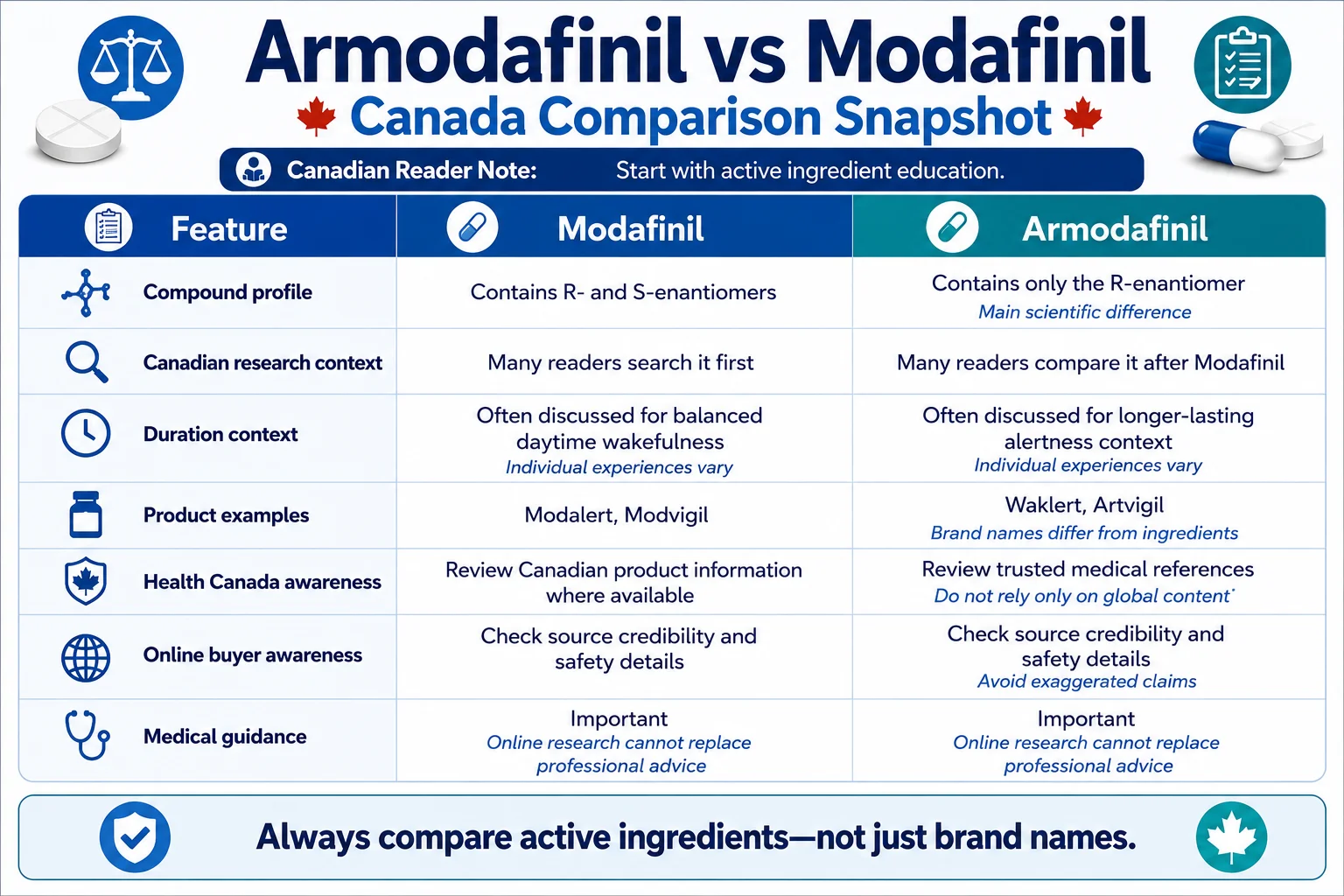
Armodafinil often appears beside Modafinil in online searches, and their similar names can make the two seem interchangeable. They are closely related medicines, but they are not identical.
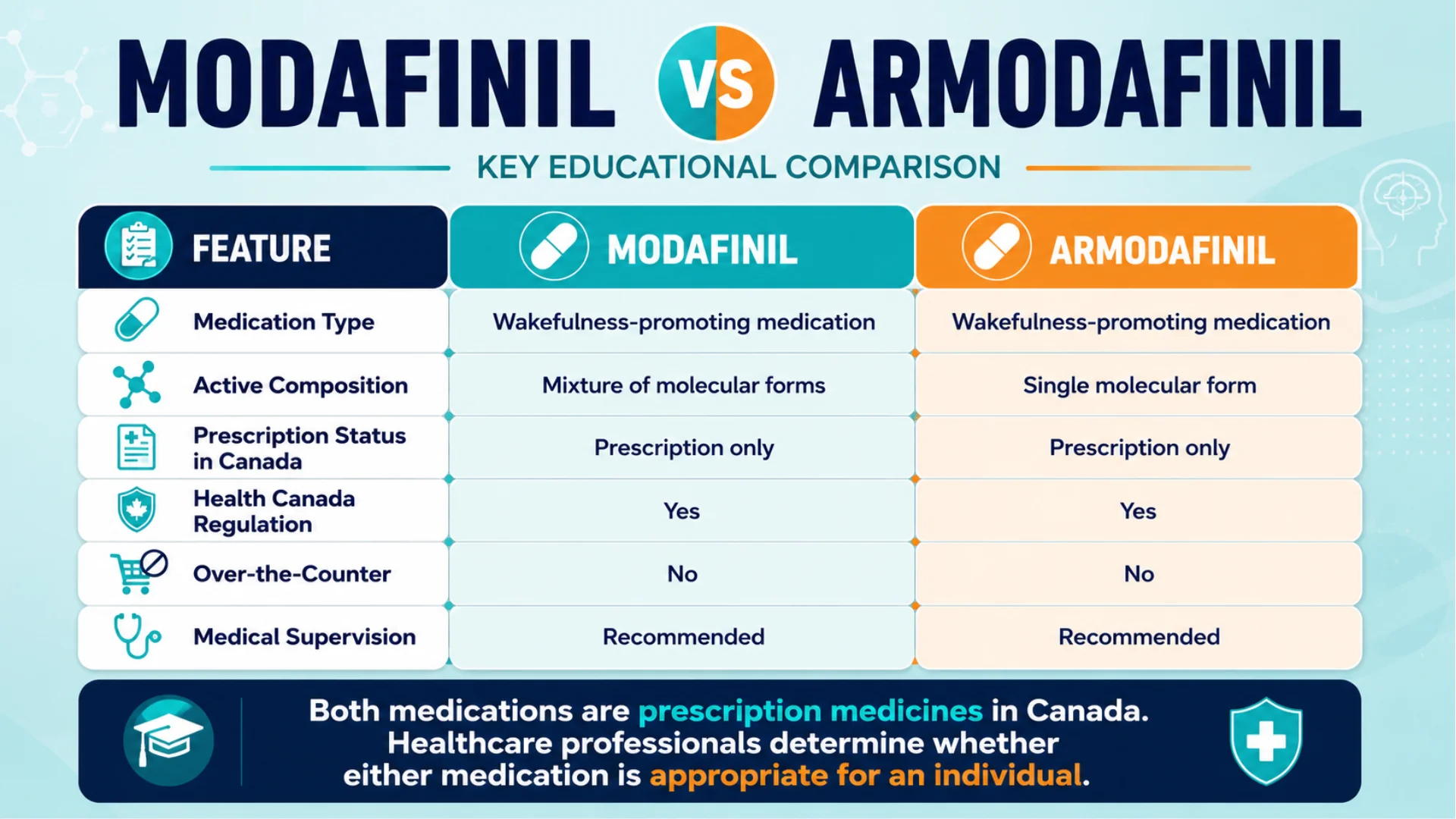
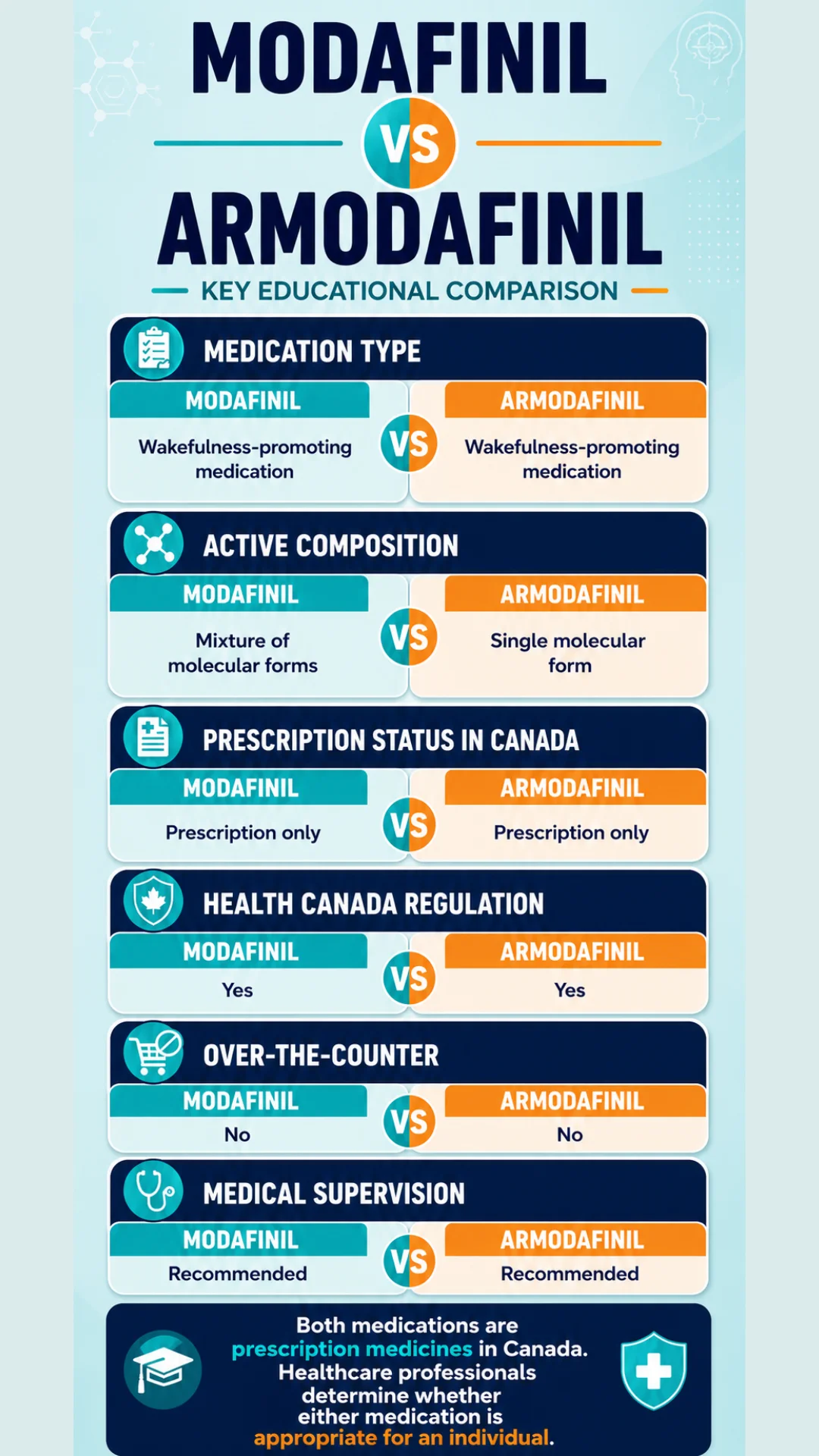
Modafinil contains two mirror-image forms, or enantiomers, of the molecule. In simple terms, enantiomers have the same basic chemical composition but differ in their three-dimensional arrangement. Armodafinil contains the R-enantiomer. This distinction contributes to differences in their pharmacological profiles.
For a general Canadian reader, the main point is not to decide which medicine is “better.” Instead, readers should recognize that evidence, product information, and regulatory details for one should not automatically be transferred to the other.
The Modafinil versus Armodafinil comparison for Canadian readers explains the distinction in more detail.
Similarly, readers researching international Armodafinil products should keep ingredient information separate from Canadian regulatory status. The broader Armodafinil Canada research guide provides additional context for evaluating product and online information without assuming that international availability equals Canadian authorization.
Overall, comparison is useful when it clarifies differences. It becomes less useful when it reduces two prescription medicines to competing consumer products.
Safety Considerations When Researching Modafinil in Canada
Any useful guide to modafinil canada needs to place safety alongside potential clinical usefulness rather than treating it as an afterthought.
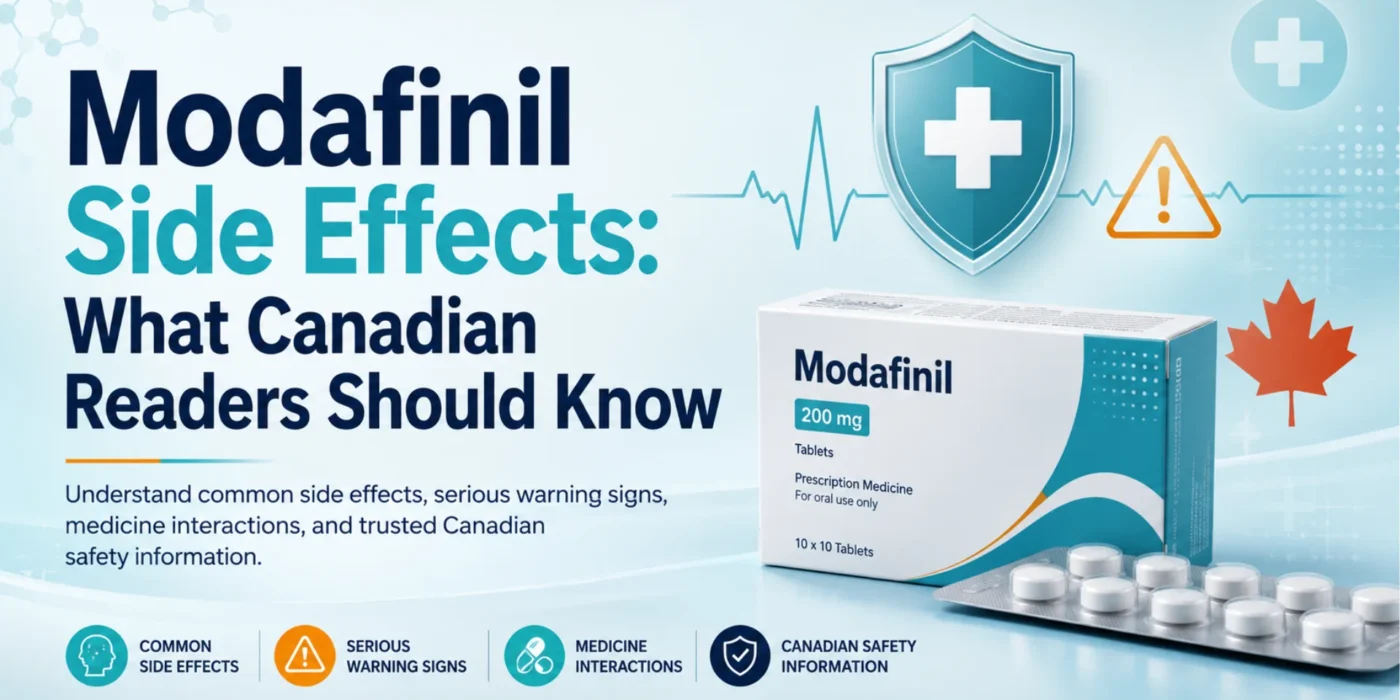
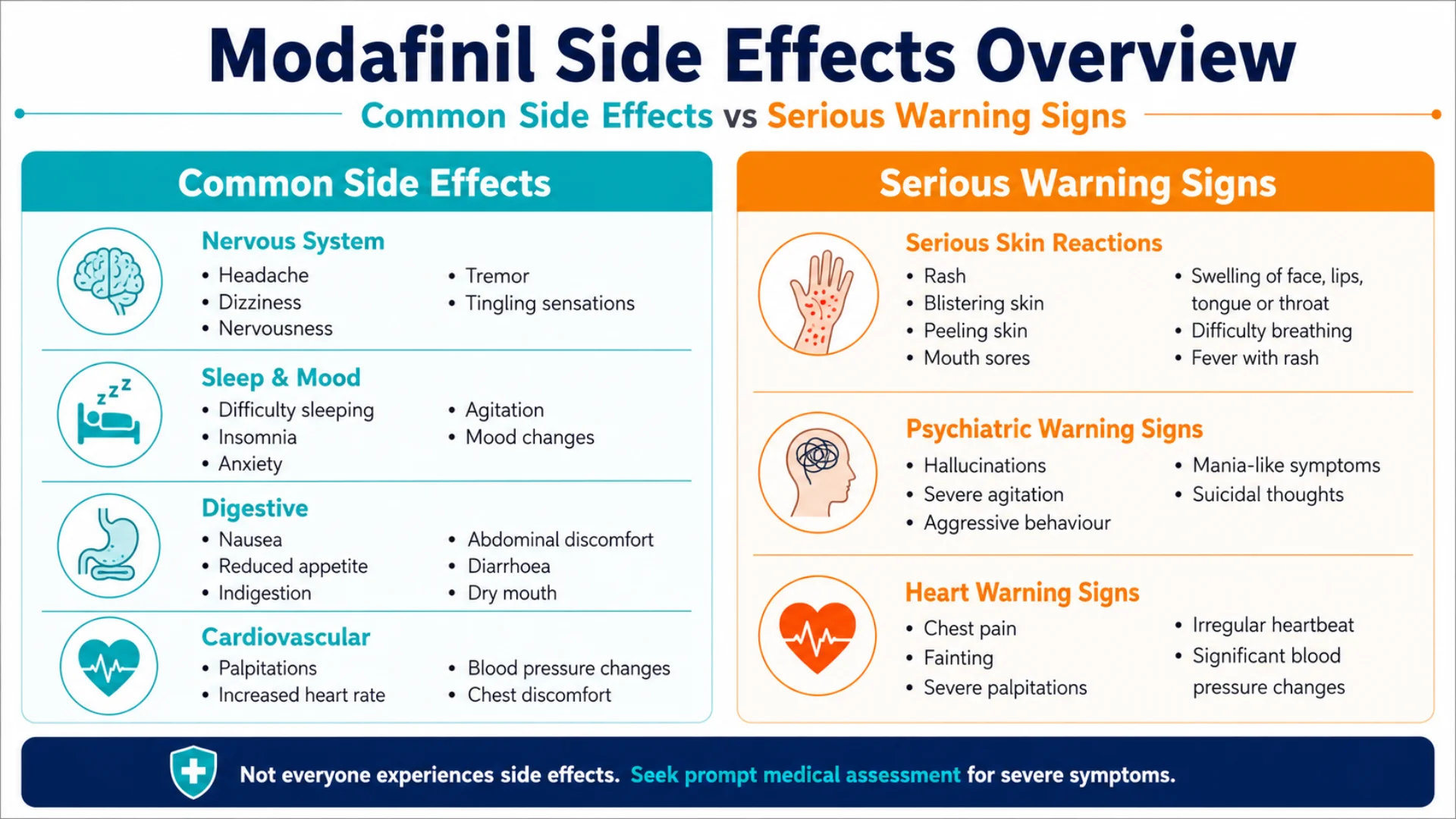
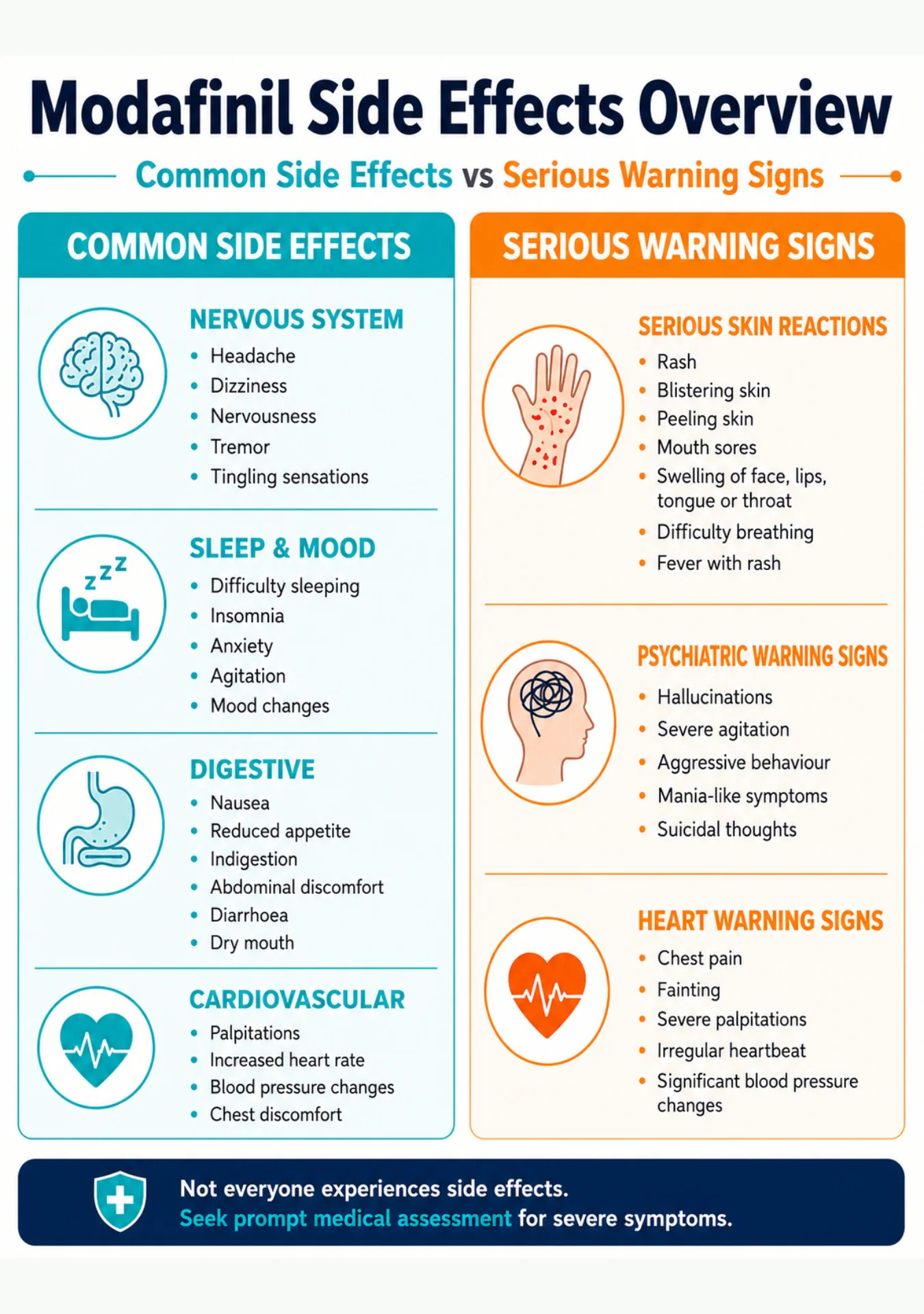
Like other prescription medicines, Modafinil can cause adverse effects. Commonly discussed effects include headache, nausea, nervousness, and difficulty sleeping, although the type and significance of an adverse effect can vary.
More serious reactions are also possible. Therefore, a short online list of side effects cannot determine whether Modafinil is suitable for an individual or whether a new symptom is medically important.
Personal health history matters. So can other medicines and health conditions.
For a broader overview of adverse-effect considerations, see the dedicated guide to Modafinil side effects for Canadian readers. MedlinePlus also provides Modafinil drug information, including safety information intended to support informed medicine discussions.
Drug Interactions Require Individual Attention
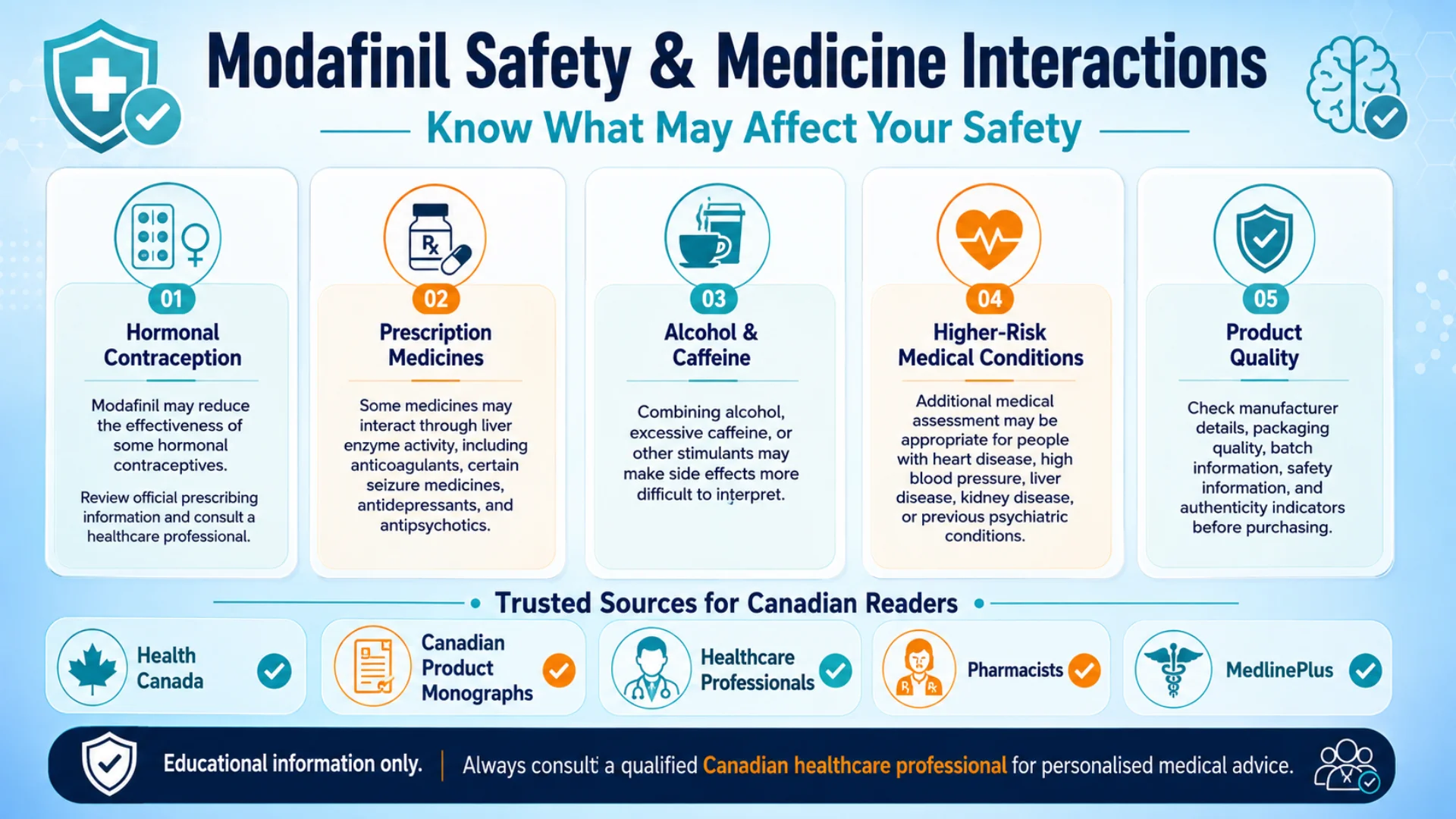
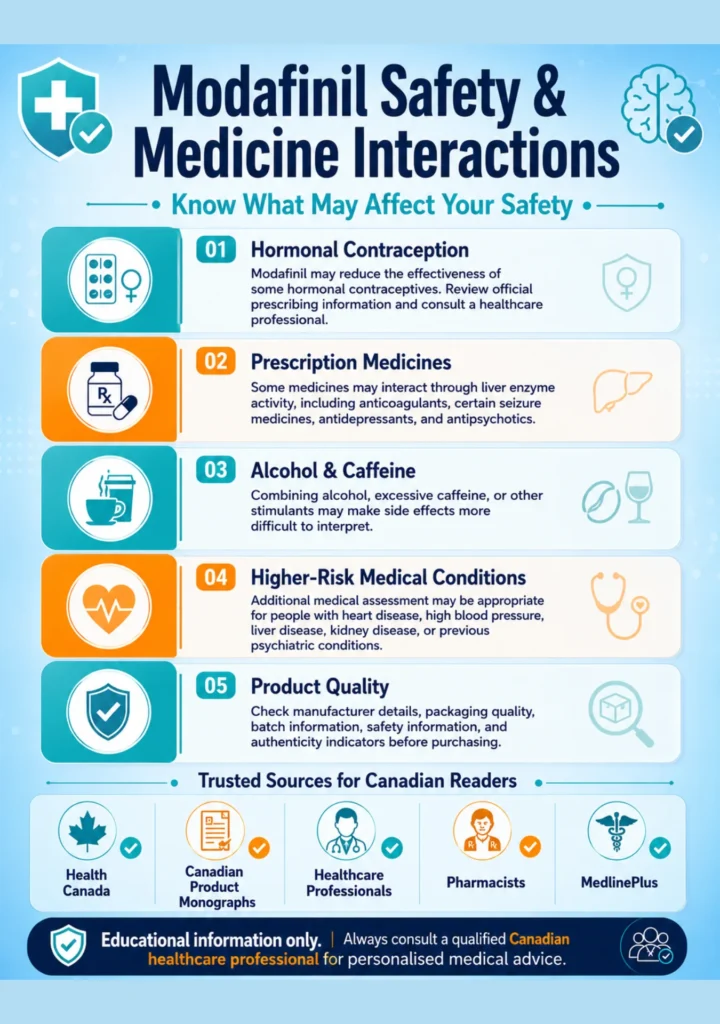
Medication safety involves more than side effects caused by one medicine in isolation. Modafinil can affect how the body handles certain medicines, while other treatments or medical factors may change the overall safety assessment.
As a result, a complete medication history matters. That includes prescription medicines and other substances or health products a person uses.
A pharmacist or prescriber can assess questions that a general article cannot answer. For example, they can consider whether a potential interaction matters for a particular medication combination, whether symptoms require attention, and whether an individual’s medical history changes the considerations around treatment.
Online interaction lists can provide general awareness. However, they should not become a substitute for individualized professional review.
Rare Does Not Mean Irrelevant
Readers should also avoid interpreting “rare” as “impossible.” Serious hypersensitivity or skin reactions and other significant adverse events can occur with Modafinil. New or concerning symptoms require appropriate medical evaluation rather than self-diagnosis through search results.
At the same time, readers should not interpret safety information in an alarmist way. A long list of possible adverse events does not mean every person will experience them.
Therefore, the appropriate conclusion is measured: general safety information identifies possibilities; professional assessment helps determine their relevance to an individual.
Modafinil and Sleep in Canada: The Limits of Wakefulness
Discussions about Modafinil often focus on how long a person can remain awake. However, that framing can obscure the more important issue: wakefulness and restorative sleep perform different roles.
Sleep contributes to memory, learning, emotional regulation, physical recovery, and many other biological processes. A wakefulness-promoting effect does not reproduce those functions.
For example, someone may feel more alert while still carrying the effects of inadequate sleep. Subjective alertness also does not guarantee that judgement, reaction time, memory, or complex decision-making has returned to an optimal level.
Therefore, Modafinil should not be framed as a way to make sleep unnecessary. That claim would go beyond its medical role and ignore the broader functions of sleep.
This point also helps explain why productivity claims require caution. More waking hours are not automatically more useful hours, especially when inadequate sleep remains part of the underlying situation.
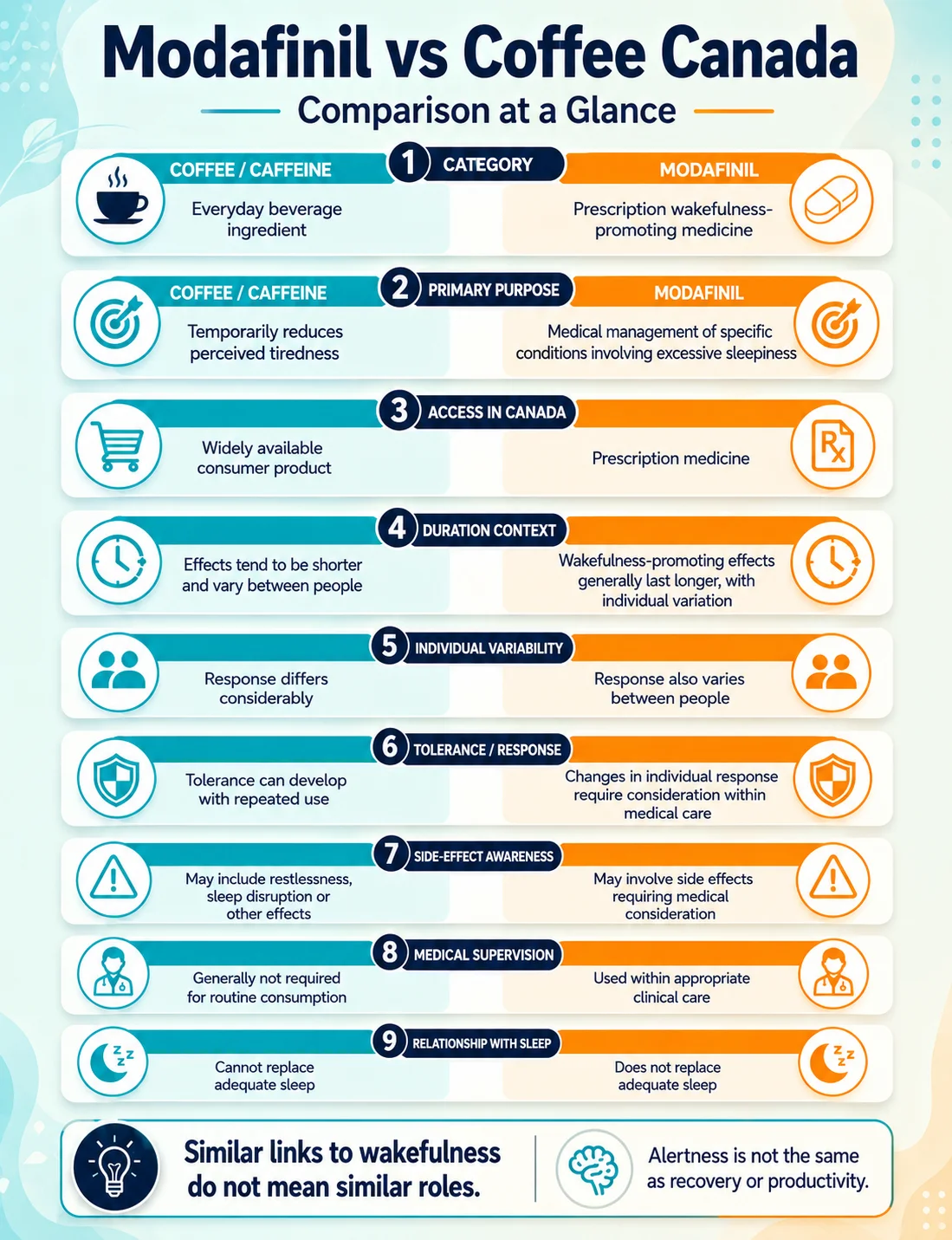
Modafinil vs Coffee in Canada: More Than a Question of Strength
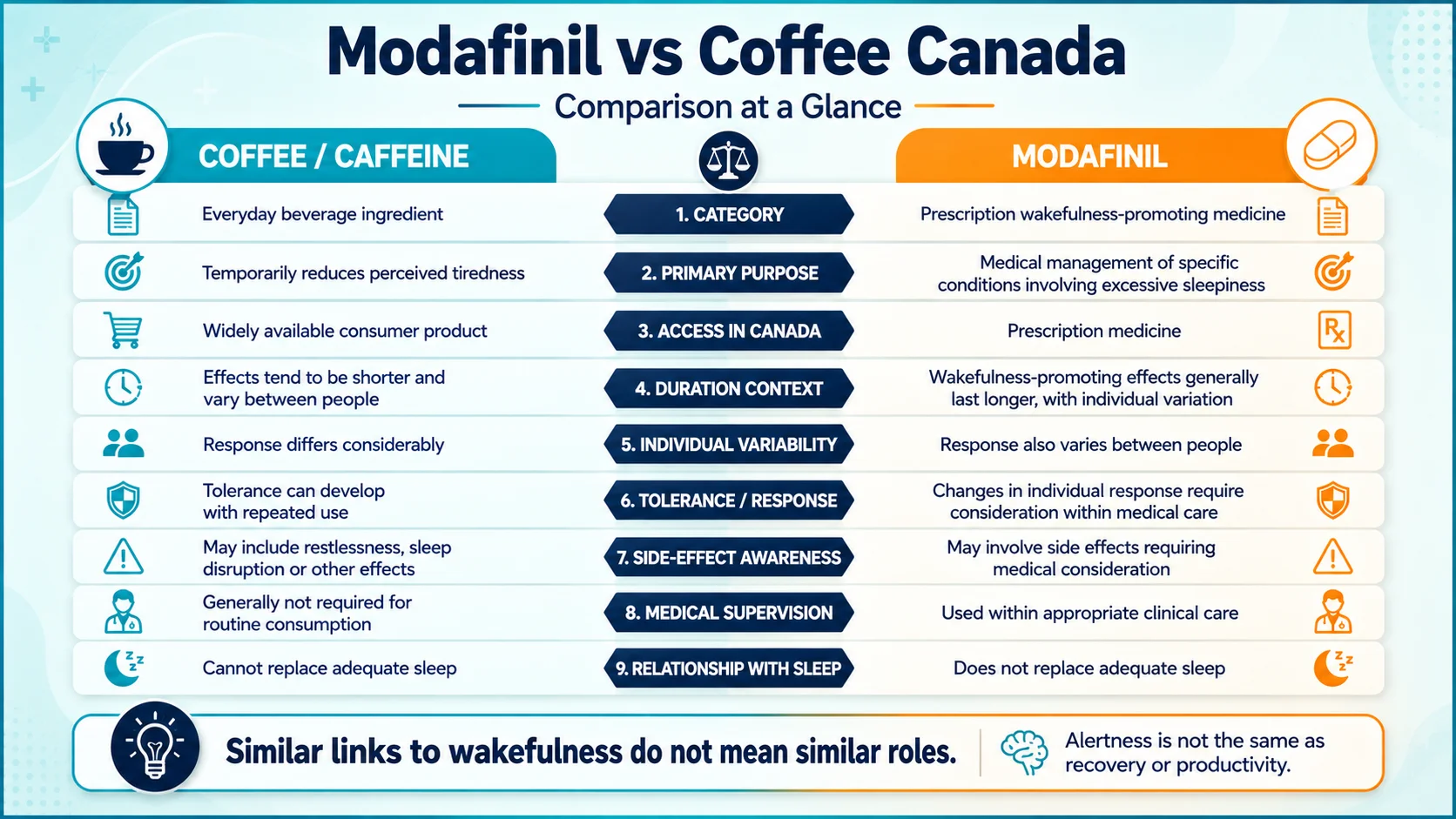
Coffee provides a useful reference point because caffeine is familiar to many adults. However, comparing a cup of coffee directly with a prescription wakefulness medicine can create a false equivalence.
Caffeine is a widely consumed stimulant found in coffee, tea, and many other beverages and products. Modafinil is a prescription medicine with a different pharmacological profile and medical context.
Both may appear in conversations about alertness, but that shared outcome does not make them interchangeable.
Instead, the more useful comparison concerns context. People commonly consume coffee as an everyday beverage. Modafinil belongs within a prescription-medicine framework that includes clinical assessment, contraindications, interactions, and adverse effects. A contraindication, in plain language, is a circumstance in which using a medicine may be inappropriate because of a particular risk.
The detailed Modafinil versus coffee comparison for Canadian readers examines these differences without reducing the question to which substance feels “stronger.”
Neither caffeine nor a wakefulness-promoting medicine should be viewed as a substitute for sufficient sleep. Moreover, the fact that someone routinely tolerates caffeine says little about whether Modafinil would be medically appropriate for that person.
This illustrates a broader rule for modafinil canada research: two substances associated with alertness can still differ substantially in evidence, regulation, pharmacology, and risk.
Modafinil Drug Interactions and Individual Safety
Canadian searches for Modafinil often expose readers to names such as Modalert, Modvigil, and products from various international manufacturers. Consequently, readers can easily lose track of what a name actually identifies.
An active ingredient is the pharmacologically active substance in a medicine. A brand or product name identifies a particular commercial product. A manufacturer is the company responsible for making that product.
These terms should not be substituted for one another.
For example, two products may state that they contain Modafinil while having different manufacturers, packaging, regulatory histories, or markets of sale. The fact that both refer to the same active ingredient does not prove that every other characteristic is identical.
A product page for Modalert 200mg, for instance, describes a particular named product. It should not be treated as defining Modafinil as an active ingredient, nor does the existence of that international product page establish Canadian authorization or individual medical suitability.
Likewise, familiarity with a brand name from international forums does not establish its regulatory status in Canada.
Product strength is another piece of product information rather than an instruction for personal use. Seeing different strengths listed online should not be interpreted as guidance about what an individual should take.
Importantly, commercial pages can blur the line between describing a product and making medical claims about what it will do. Readers should therefore keep ingredient identity, product identity, regulatory status, and clinical suitability as separate questions.
Researching Modafinil Online Without Confusing Visibility With Legitimacy
For many people searching modafinil canada, online availability is one of the first things they encounter. The difficulty is that search engines can display legitimate medical resources, Canadian regulatory information, overseas pharmacies, marketplaces, affiliate content, forums, and promotional websites side by side.
Their appearance in the same search results does not give them equal authority.
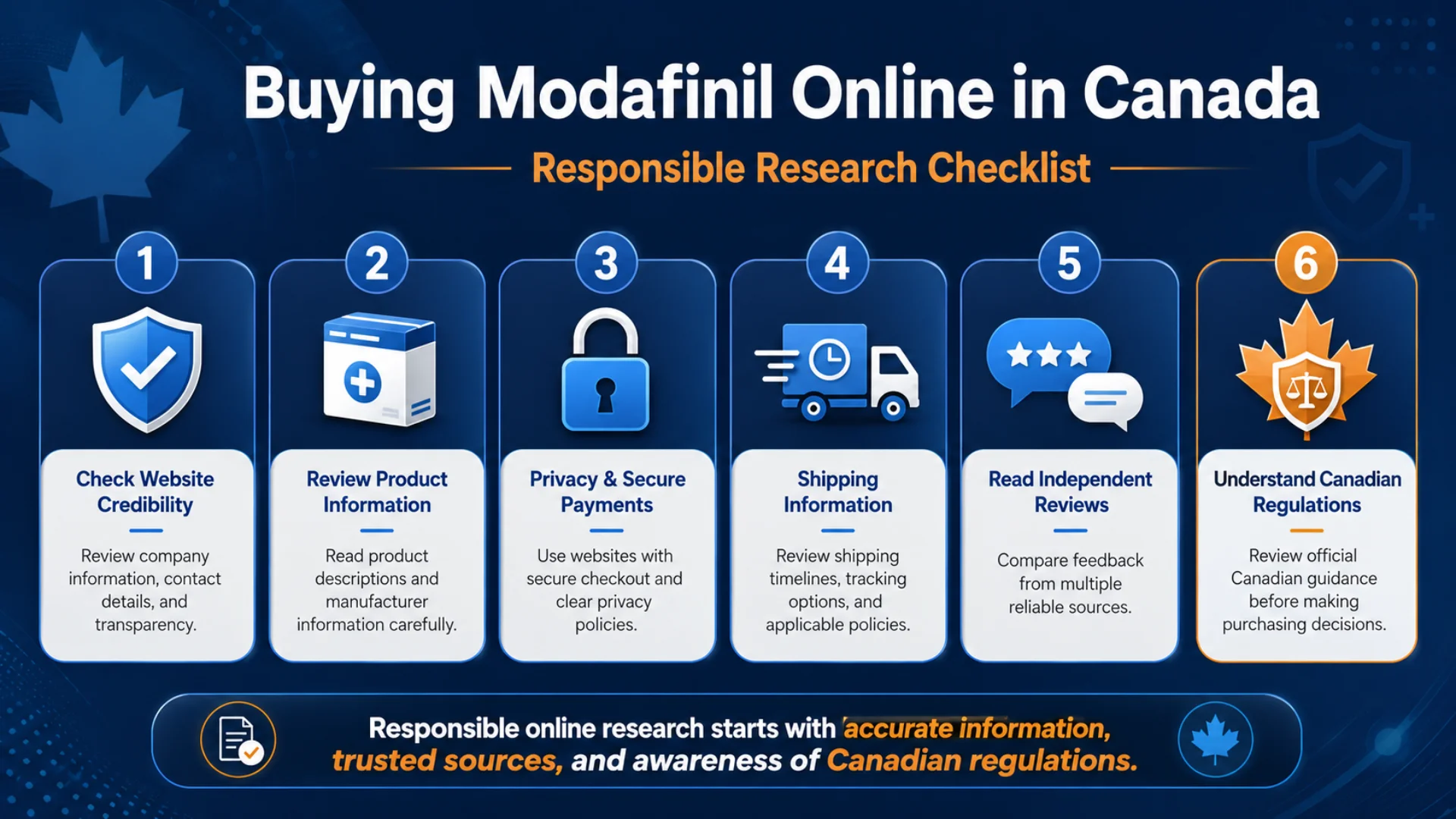
A useful online-research process begins by asking what kind of page you are viewing.
A government drug database may help answer a regulatory question. Clinical or professional medical information may explain uses, evidence, and safety. A product page describes what a seller says it offers. Meanwhile, a forum records users’ experiences. Each source can contain information, but each has different limits.
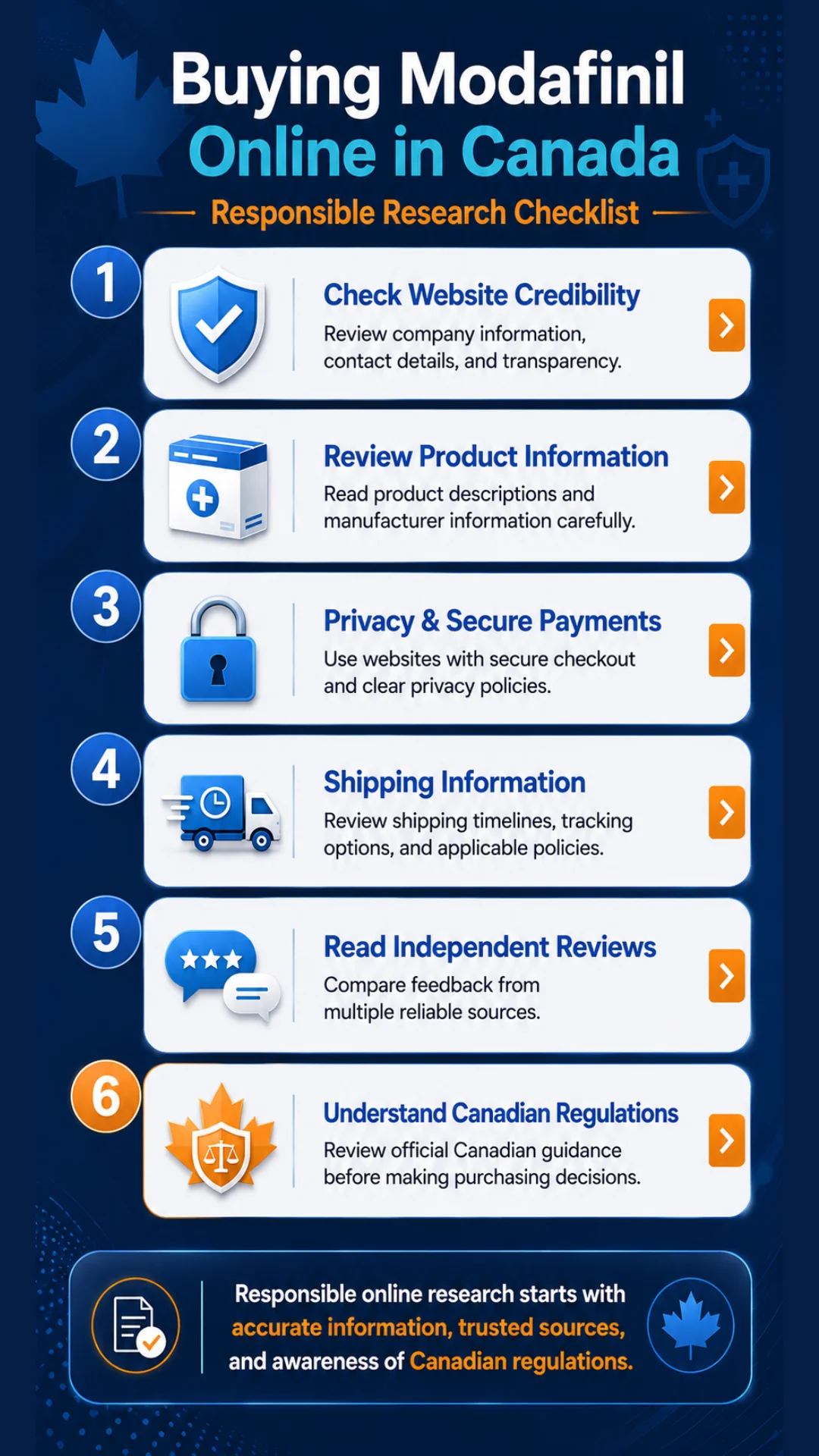
The dedicated guide to researching Modafinil online in Canada explores these distinctions in greater detail. Health Canada also provides guidance for consumers on buying drugs over the internet, including risks associated with online sources.
Seller Transparency Is Evidence to Examine, Not a Guarantee
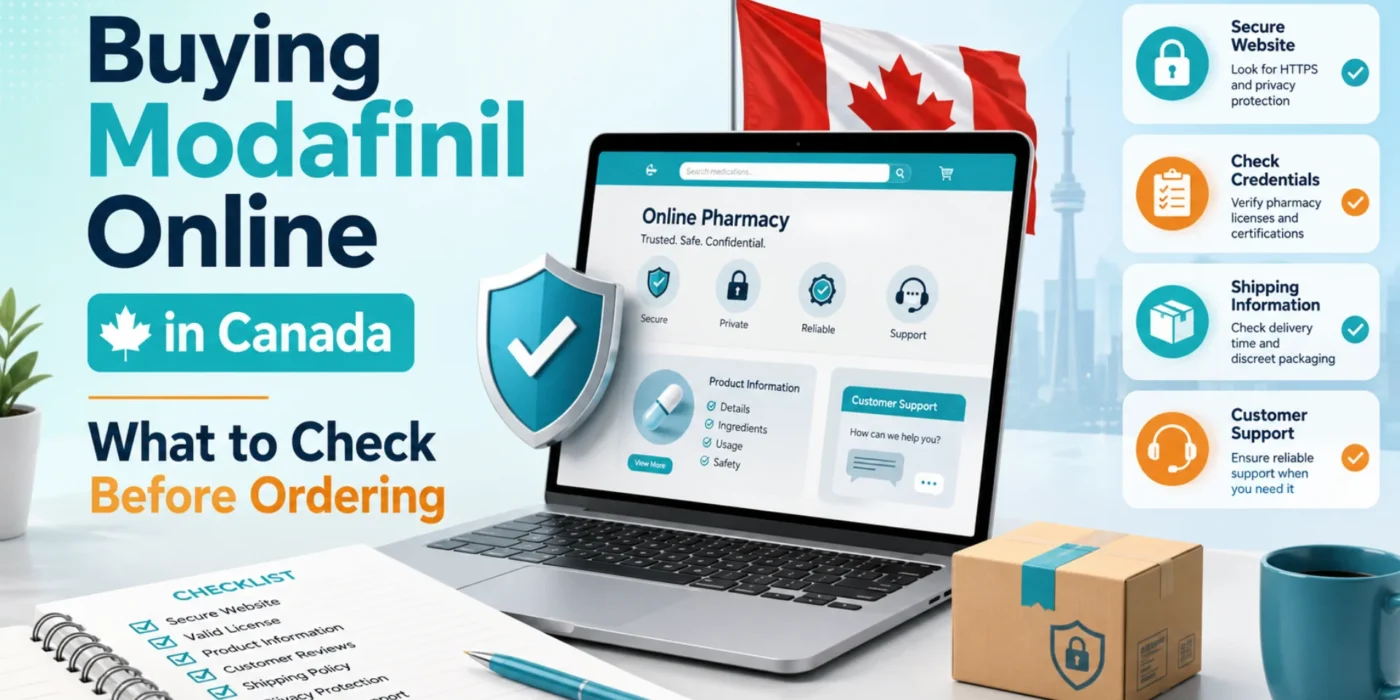
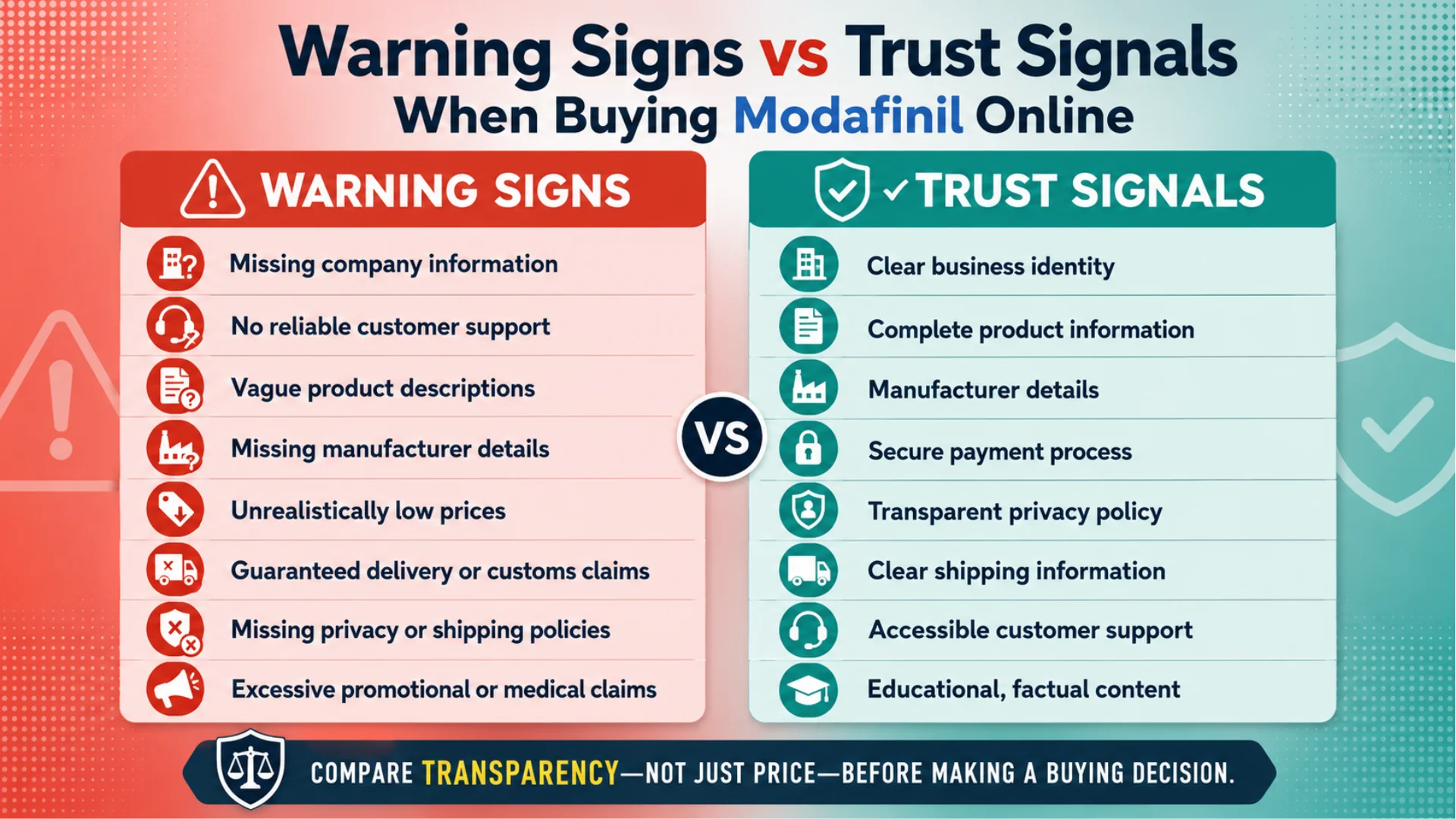
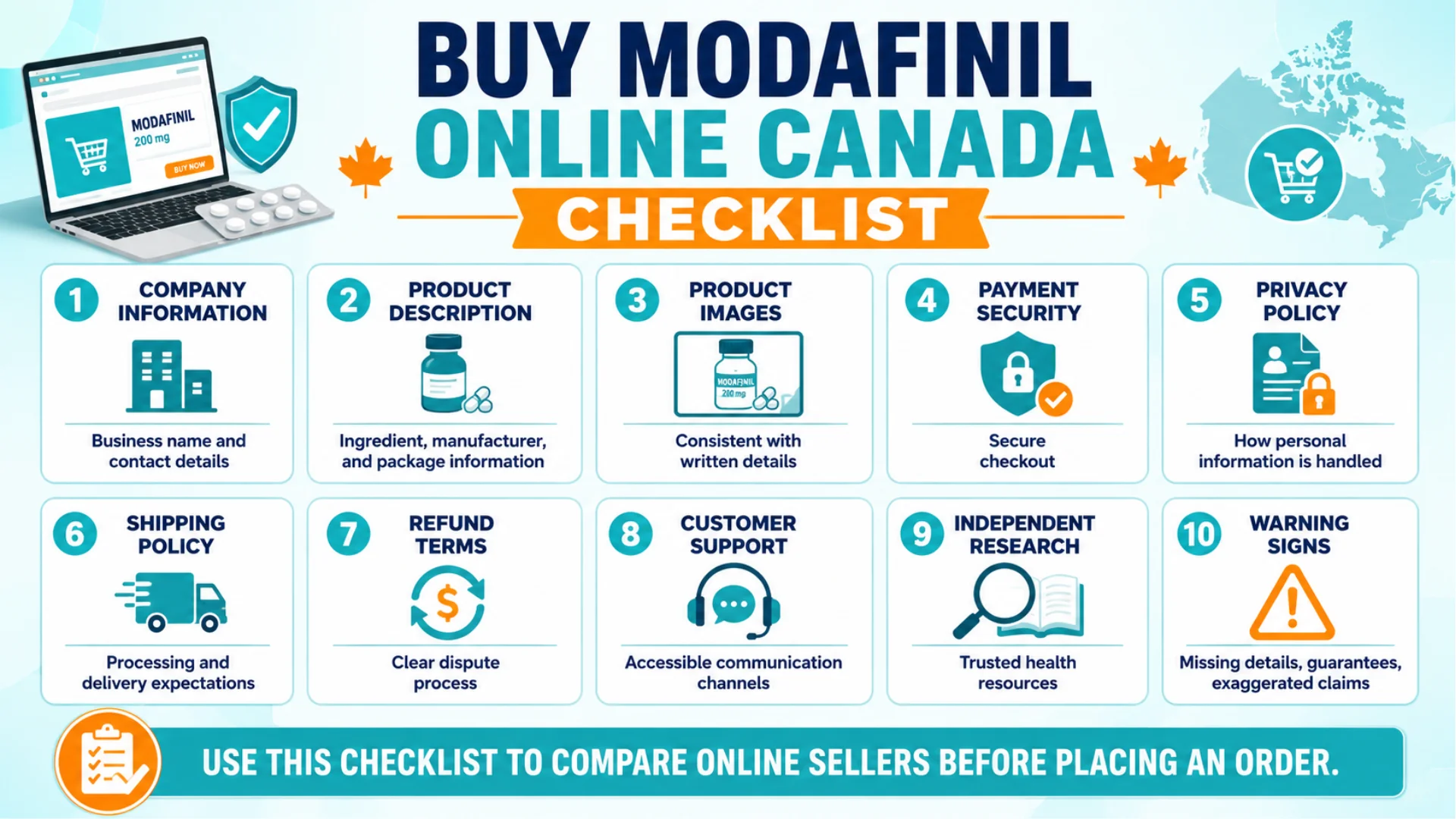
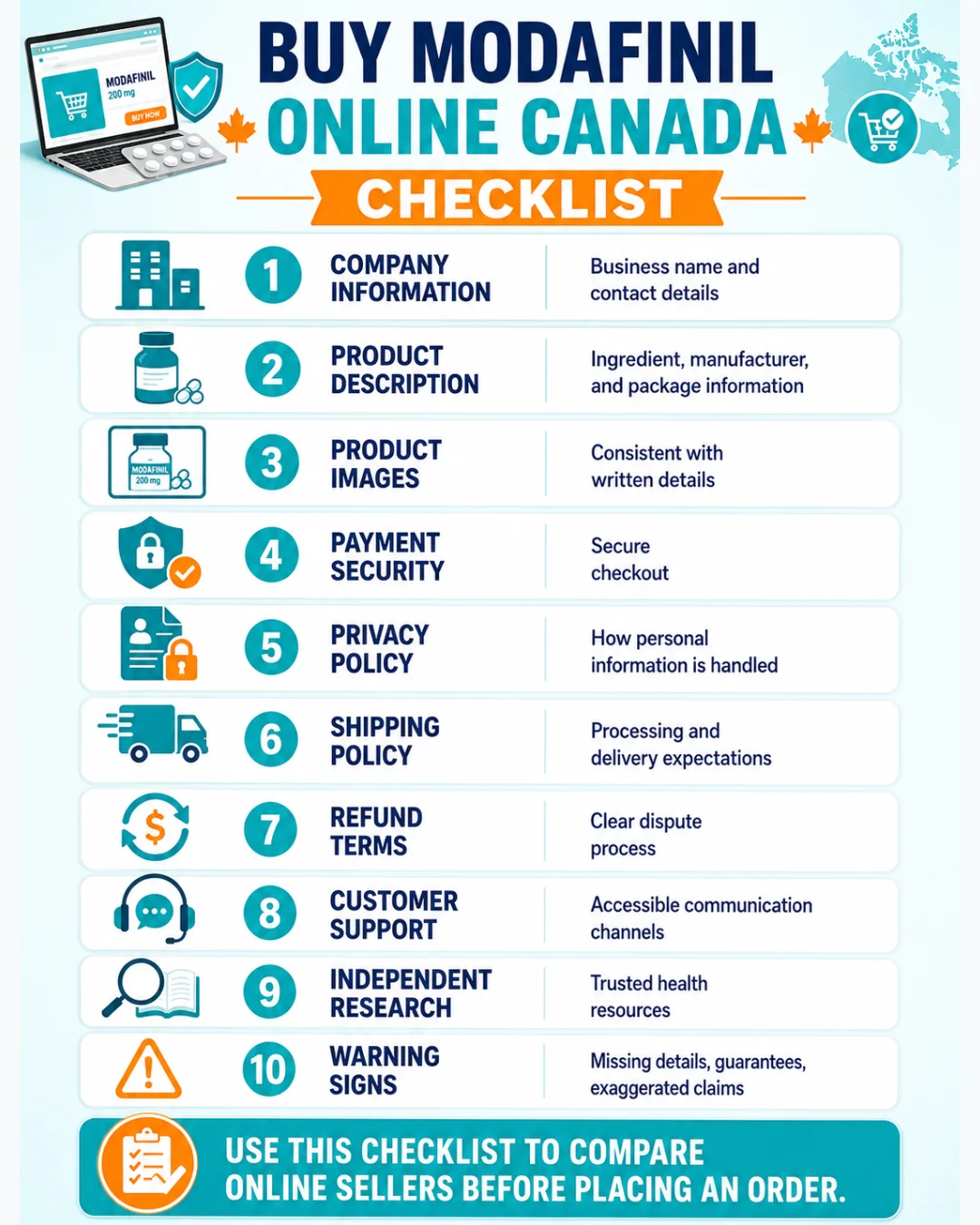
When evaluating online product information, basic transparency matters. For example, readers may consider whether a site clearly identifies products and manufacturers, provides meaningful contact and policy information, distinguishes education from advertising, and avoids implausible health guarantees.
However, no single website feature proves that a medicine is authentic, authorized, or suitable for an individual.
Claims such as “completely safe,” “guaranteed concentration,” “no side effects,” or universal suitability should prompt particular caution because prescription medicines do not affect everyone in the same way.
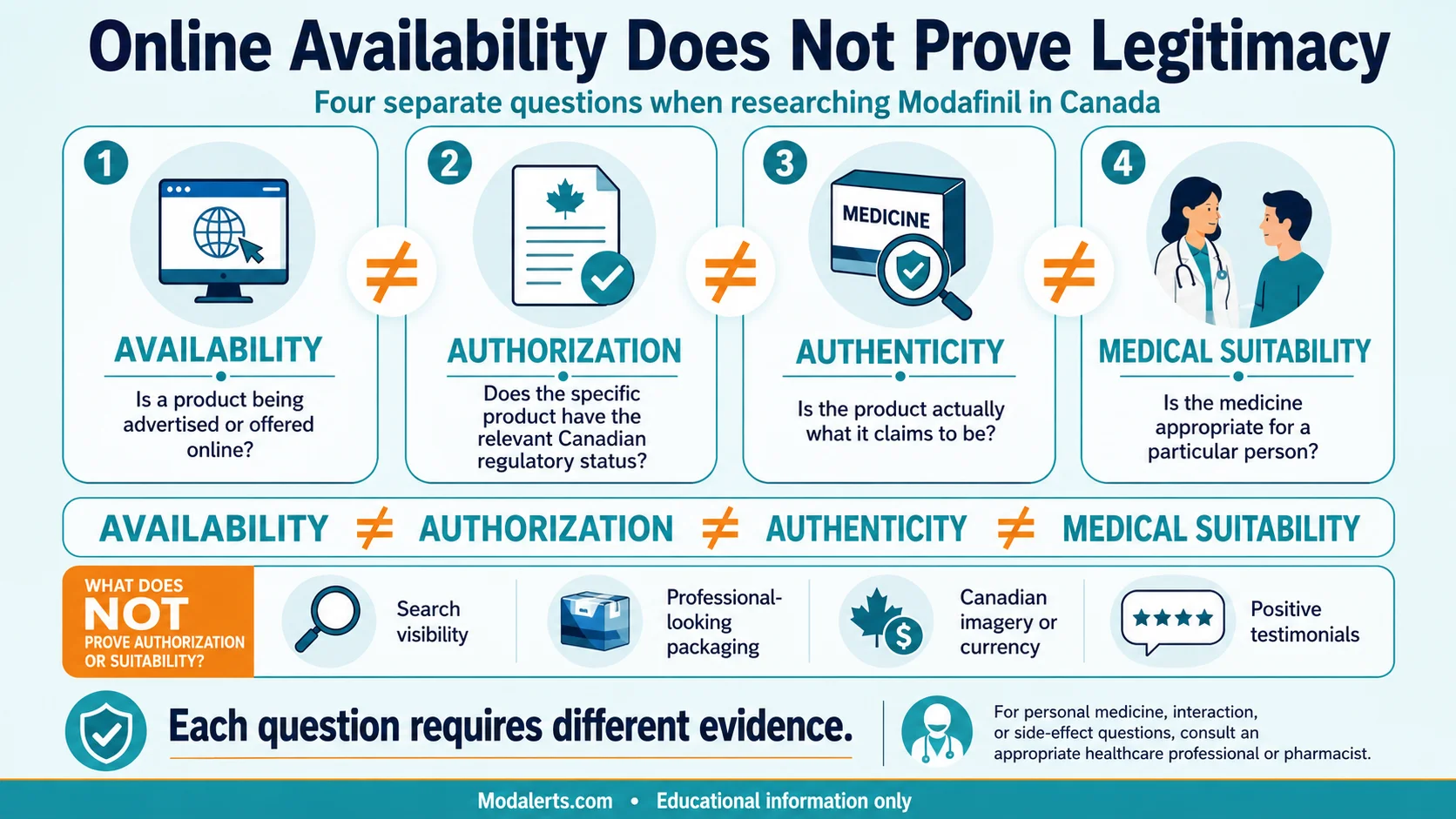
Canadian consumers should also be careful when an international website uses Canadian imagery, currency, or geographic wording. Marketing to Canadians and holding Canadian regulatory authorization are separate matters.
Therefore, polished design, familiar payment methods, Canadian flags, or positive reviews should never carry more evidentiary weight than they can support.
Modafinil Product Authenticity Cannot Be Established by Appearance Alone
Photos of blister packs, manufacturer logos, and professional-looking packaging may provide product-identification clues. However, images on a website cannot independently establish the contents or authenticity of a medicine.
The same caution applies to user-posted photographs. A visual match may help someone recognize packaging, but it cannot confirm what a tablet contains, how it was stored, or whether the photographed item matches another product offered elsewhere.
This is one reason online medicine research requires more than visual comparison.
The broader principle is worth remembering:
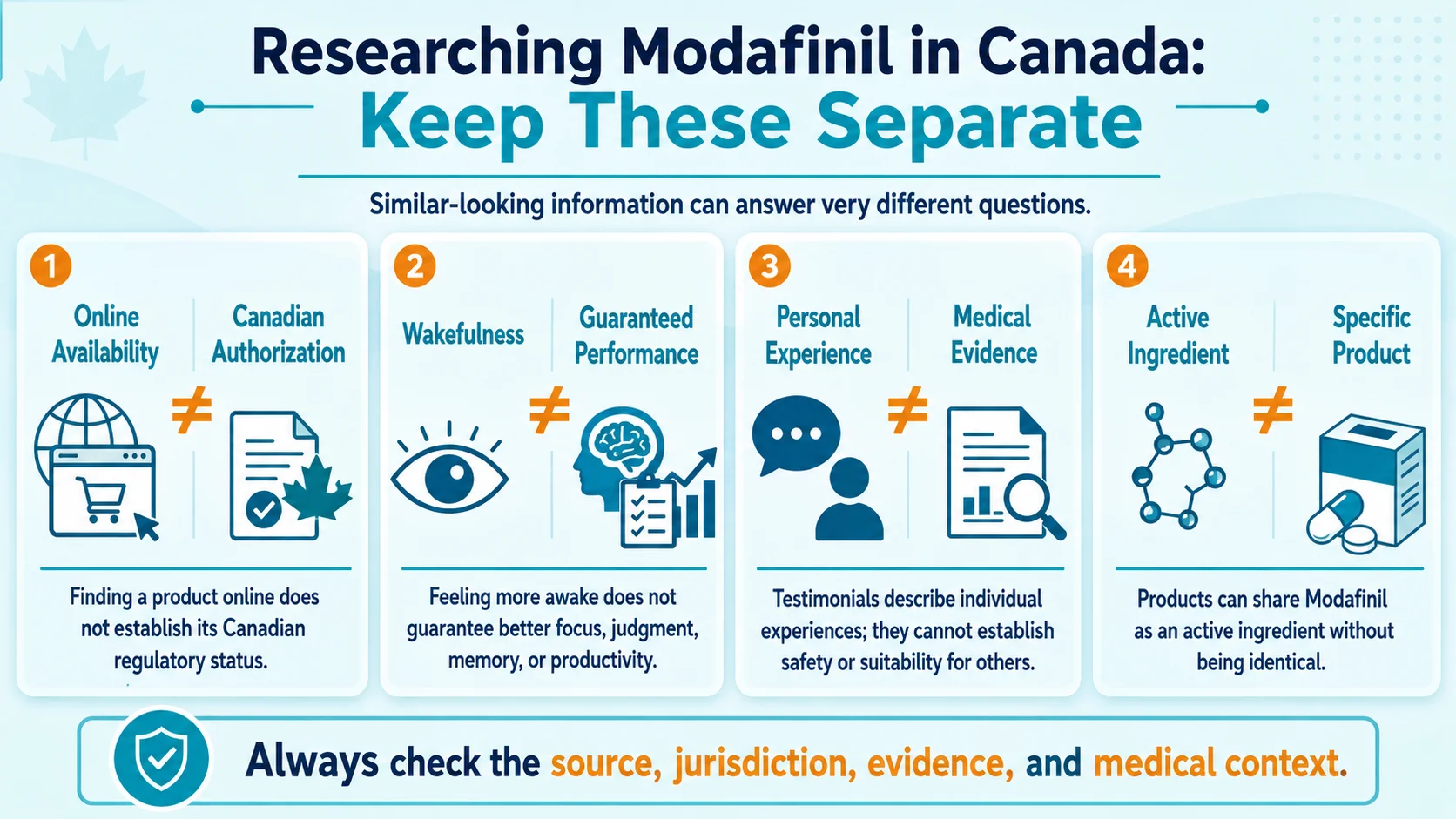
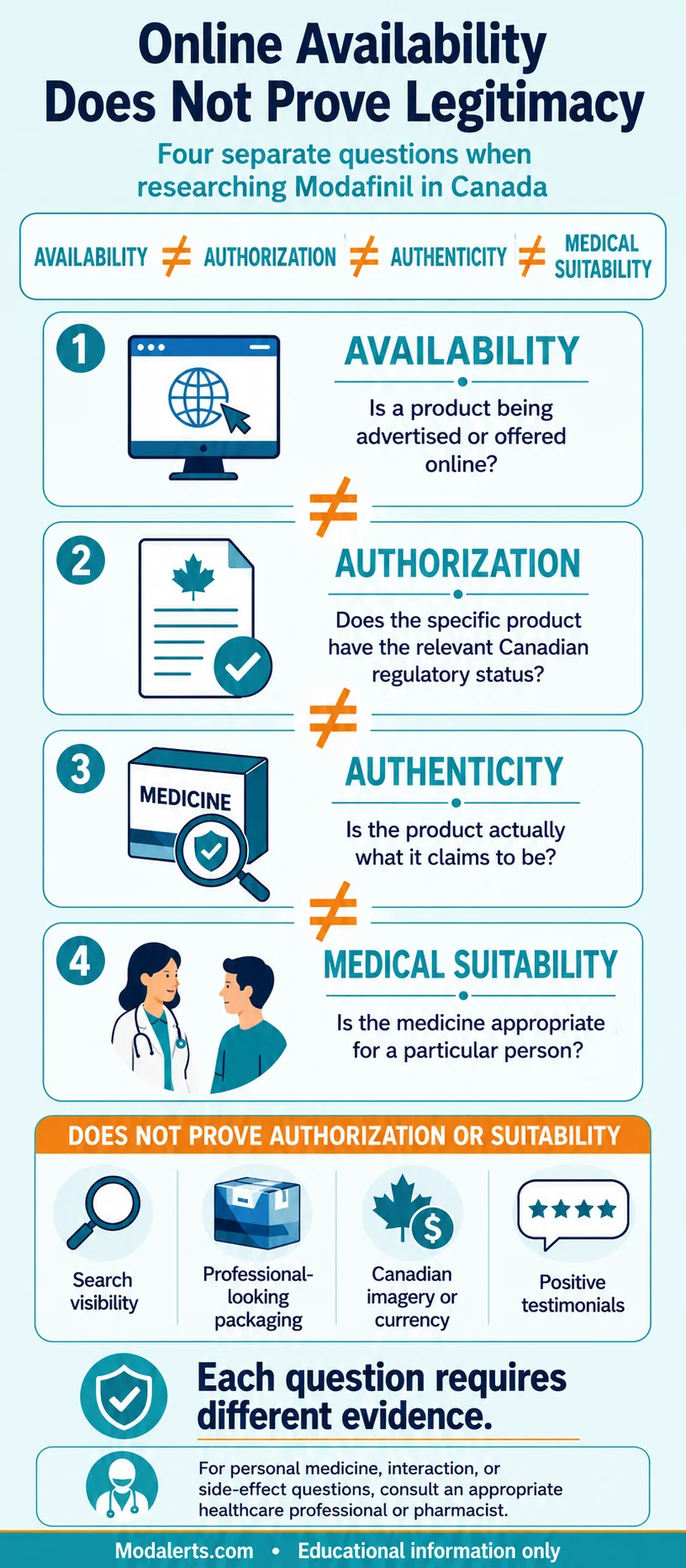
availability ≠ authorization ≠ authenticity ≠ medical suitability.
Each is a separate question, and each requires different evidence.
Four Types of Information and Why Mixing Them Causes Confusion
A large proportion of misleading Modafinil content comes not from one obviously false statement but from combining different kinds of evidence as though they were equivalent.
Canadian readers can make their research more reliable by sorting information into four broad categories.
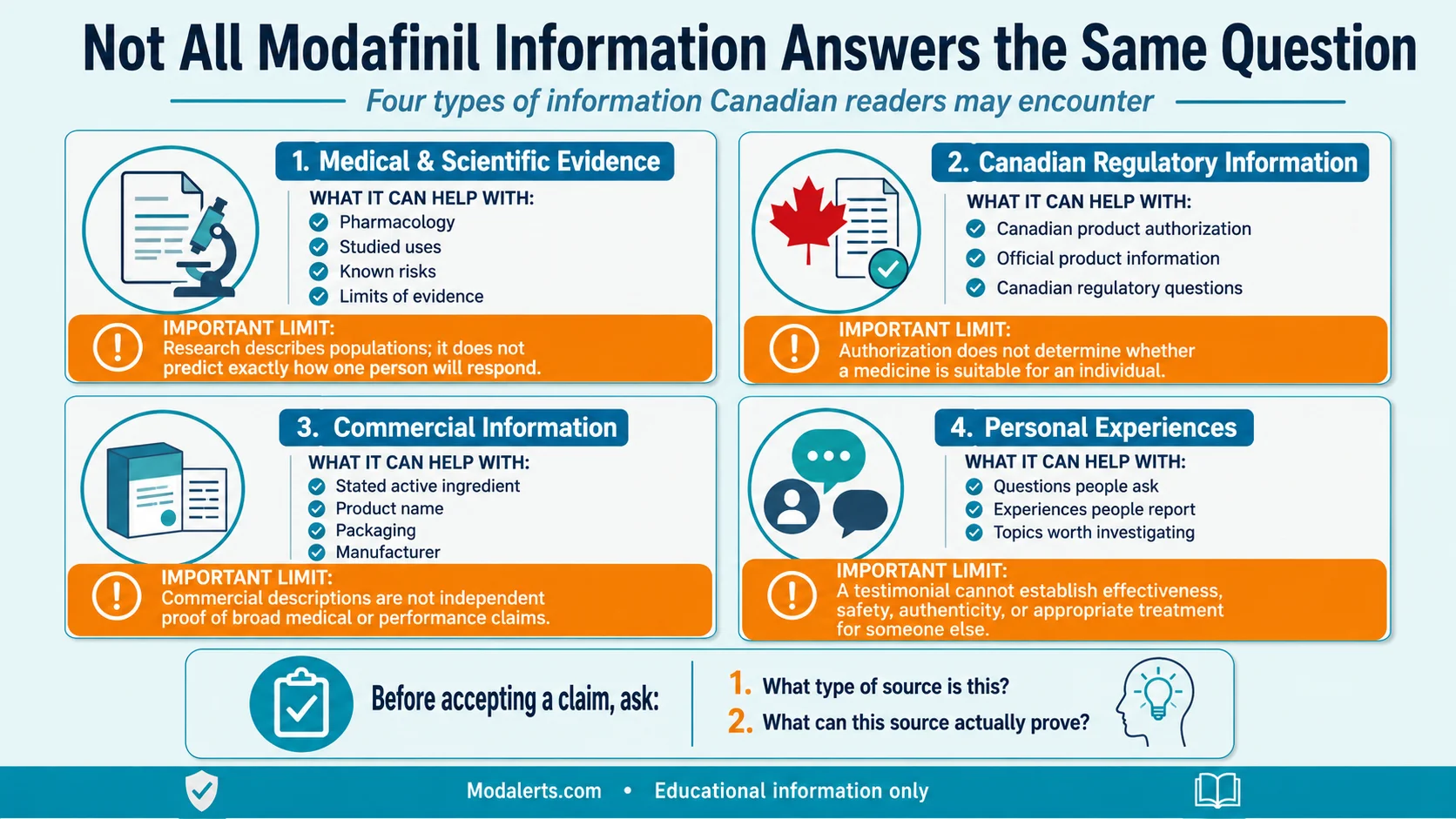
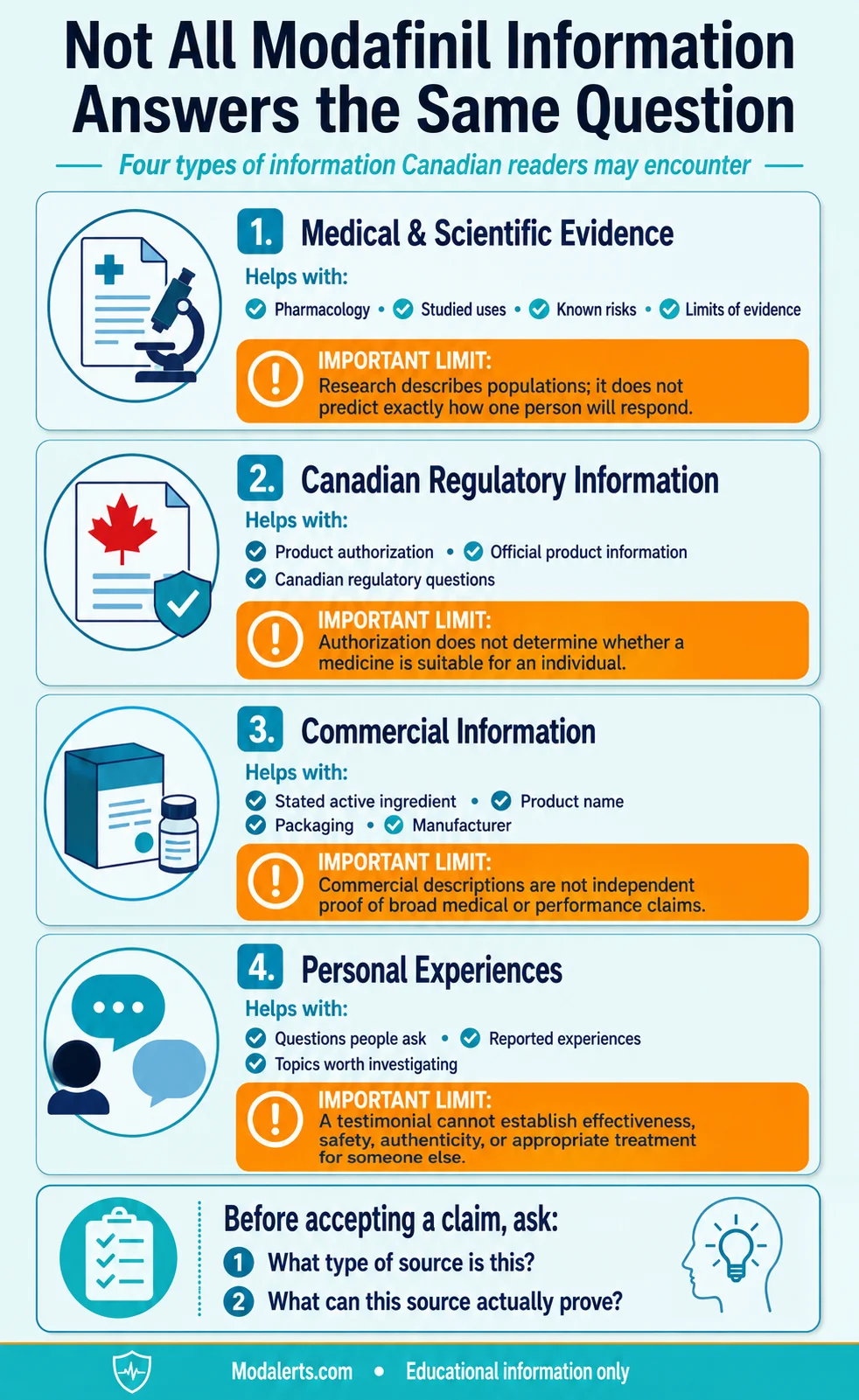
1. Medical and Scientific Evidence
This category includes clinical research, professional drug information, and evidence-based medical guidance. It can help answer questions about pharmacology, studied uses, known risks, and the limits of current evidence.
Even strong research usually describes populations rather than predicting exactly how one person will respond. Moreover, a finding in one study population may not apply equally to people with different health conditions, sleep patterns, or reasons for considering the medicine.
Scientific evidence should therefore inform claims rather than become a source of sweeping promises.
2. Canadian Regulatory Information
Regulatory sources address questions such as Canadian product authorization and official product information. They become particularly important when international websites make statements that may apply to another jurisdiction.
However, regulatory information does not, by itself, tell an individual whether a medicine is clinically suitable for them. Authorization and personal medical suitability remain separate questions.
3. Commercial Information
Manufacturer and seller pages can provide useful details such as a stated active ingredient, product name, packaging, or manufacturer. However, commercial information has an obvious commercial purpose.
Therefore, product descriptions should not serve as independent proof of broad medical or performance claims. A seller can accurately state a product name while still making claims elsewhere that require stronger evidence.
4. Personal Experiences
Forums, reviews, and social media discussions can reveal the questions and experiences people report. In addition, they may help a reader identify topics worth investigating further.
However, they cannot establish effectiveness, safety, authenticity, or appropriate treatment for another person.
A testimonial saying “this helped me work all night” does not show that the medicine was medically appropriate, that the product contained what the user believed it contained, or that another person would have the same experience.
Research checkpoint: Before accepting a claim, identify whether it comes from clinical evidence, Canadian regulatory information, a commercial source, or personal experience. Then ask whether that type of source can actually support the claim being made.
Modafinil Testimonials and Personal Experiences: Limited Evidence
Personal experiences deserve their own place in online research because they are both common and persuasive.
A detailed first-person account can feel more relevant than a clinical summary. Someone may describe feeling more awake, more focused, anxious, unable to sleep, unusually productive, or disappointed by the experience. Those reports can be genuine descriptions of what a person believes happened.
However, several unknowns usually remain.
The reader may not know the person’s medical history, other medicines, sleep status, expectations, product authenticity, or other factors that influenced the experience. In some online settings, it may also be difficult to know whether a review reflects an independent experience or promotional activity.
As a result, testimonials work best as sources of questions, not answers.
For example, repeated discussions of sleep difficulty may prompt someone to consult established safety information. Reports about different product names may prompt a regulatory or manufacturer search. Claims about extraordinary productivity may prompt a closer look at cognitive research.
This approach preserves what anecdotes can offer without asking them to prove more than they can.
Common Misconceptions About Modafinil in Canada
Several recurring assumptions can make Modafinil research unnecessarily confusing.
“If I can find it online, it must be approved for sale in Canada.”
Online visibility and Canadian authorization are different matters. International sellers can appear in Canadian search results regardless of a product’s regulatory status.
“If Modafinil keeps someone awake, it must improve their performance.”
Wakefulness and performance are not synonymous. Attention, judgement, memory, and task performance depend on many factors, including adequate sleep.
“A familiar brand name tells me everything about the medicine.”
Brand, manufacturer, active ingredient, and regulatory status are distinct pieces of information.
“A positive review proves a product works.”
A testimonial describes an individual’s claimed experience. It cannot establish authenticity, effectiveness, or safety for others.
“Prescription medicines are safe whenever healthy people use them.”
Prescription status does not imply universal suitability. Health history, interactions, adverse effects, and individual circumstances matter.
“Modafinil can replace sleep.”
Promoting wakefulness does not remove the biological need for sleep or reproduce all of sleep’s functions.
Overall, these distinctions are useful well beyond Modafinil. They are basic principles for evaluating health information in an online environment where medical, commercial, and anecdotal content frequently overlap.
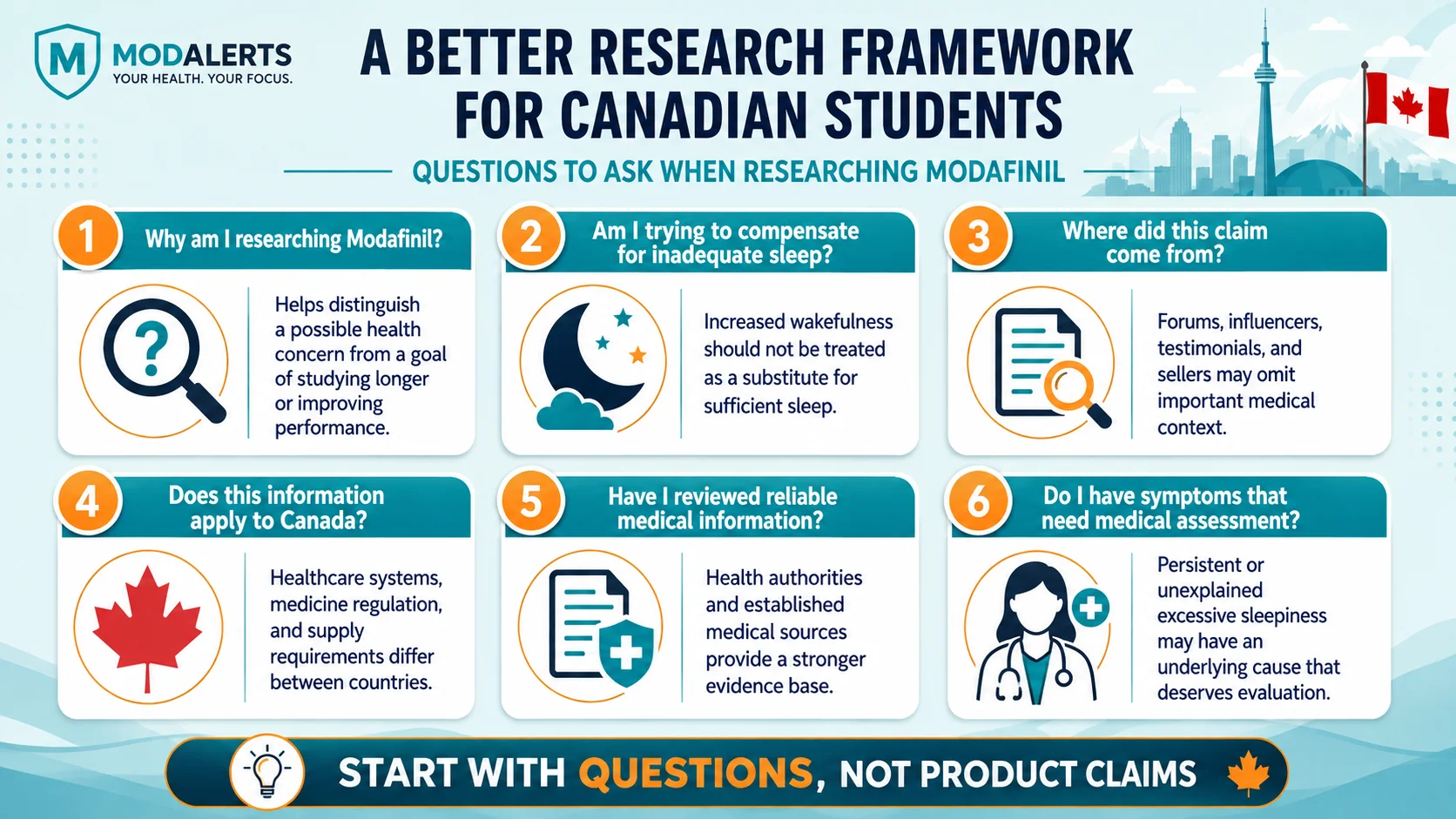
A Responsible Framework for Modafinil Canada Research
Instead of beginning with a product and working backwards, readers can approach modafinil canada research in a more structured order.
First, define the question. Someone investigating persistent excessive sleepiness has a different information need from someone comparing international product names.
Second, identify the type of evidence needed. Medical questions require medical evidence; Canadian authorization questions require Canadian regulatory information; individual treatment questions require professional assessment.
Third, check the jurisdiction. Information written for another country may be medically informative while still being unsuitable for answering Canadian regulatory questions.
Fourth, separate ingredient from product. Verify whether a source discusses Modafinil generally or makes a claim about a particular brand, manufacturer, or product.
Fifth, look for the limits of the claim. Reliable medical information usually acknowledges uncertainty, adverse effects, individual variation, and the boundaries of existing evidence.
Finally, escalate personal questions appropriately. A pharmacist or other qualified healthcare professional is better positioned to address interactions, individual suitability, medical symptoms, and medication-specific concerns than an anonymous review or commercial product description.
This framework avoids two extremes: assuming everything online is unreliable or treating everything that looks professional as equally trustworthy.
Key Takeaways for Canadian Modafinil Research
- Modafinil is a prescription wakefulness-promoting medicine, not a guaranteed cognitive or productivity enhancer.
- Canadian prescription status, product authorization, online availability, product authenticity, and individual medical suitability are separate questions.
- Wakefulness does not remove the biological need for sleep or guarantee better memory, judgement, grades, or workplace performance.
- Modafinil and Armodafinil are related medicines, but readers should not assume that their evidence, products, or regulatory details are interchangeable.
- Side effects and drug interactions require appropriate attention, while personal medical questions belong with qualified healthcare professionals or pharmacists.
- An active ingredient is different from a brand, manufacturer, or specific commercial product.
- International availability does not establish Canadian authorization.
- Commercial pages and testimonials may provide information or raise useful questions, but they do not carry the same evidentiary weight as medical and regulatory sources.
- Responsible modafinil canada research starts by identifying the question and then choosing a source capable of answering it.
Frequently Asked Questions About Modafinil in Canada
The following answers address common questions briefly. Readers who want a broader set of short-form answers can also consult the dedicated Modafinil Canada FAQ.
Yes. Modafinil is a prescription medicine in Canada. However, questions about a particular product, supply situation, importation issue, or regulatory circumstance should be checked against current Canadian information rather than inferred from international websites.
Modafinil is a wakefulness-promoting medicine used clinically in relation to excessive sleepiness associated with certain sleep-wake disorders. The appropriateness of treatment depends on an individual’s diagnosis and medical circumstances.
No. They are closely related but distinct medicines. Modafinil contains two enantiomers of the molecule, while Armodafinil contains the R-enantiomer. Therefore, their product information and regulatory context should be researched separately.
No. Promoting wakefulness should not be interpreted as guaranteeing better focus, memory, grades, or workplace performance. Many factors influence cognitive performance, and research findings do not establish a universal productivity benefit.
No. A wakefulness-promoting effect does not eliminate the body’s need for sleep. Sleep supports physical health and multiple cognitive processes, and medication should not be understood as reproducing those functions.
Countries can have different medicine authorizations, product names, prescribing frameworks, and regulatory requirements. Consequently, international information may describe circumstances that do not apply directly in Canada.
Start by distinguishing the active ingredient from the product or brand. Then identify the source and its jurisdiction and separate commercial availability from Canadian authorization. Medical claims should be assessed against credible medical evidence, while Canadian regulatory questions require current Canadian sources.
Current Health Canada resources and Canadian drug-product information are appropriate starting points for regulatory and authorized-product questions. In addition, pharmacists and other qualified healthcare professionals can help interpret medicine information and address personal medication concerns.
Conclusion: Modafinil Canada
The broad search for modafinil canada is really a collection of different questions. Modafinil is a prescription wakefulness-promoting medicine, but understanding it properly also requires attention to Canadian regulation, clinical evidence, safety, product terminology, and the quality of online information.
The most important distinctions are straightforward. Wakefulness does not guarantee improved cognition or productivity. A product being visible online does not establish Canadian authorization or authenticity. An active ingredient is not the same thing as a brand or commercial product. Likewise, a testimonial is not clinical evidence, and general information cannot determine whether a prescription medicine is appropriate for a particular person.
Therefore, practical research should begin with the question rather than the product. Use Canadian regulatory sources for Canadian regulatory issues, credible medical information for evidence and safety questions, and an appropriate healthcare professional or pharmacist when the question becomes personal.
The wider Modalerts.com Canada educational cluster examines individual topics such as regulation, safety, Modafinil and Armodafinil, shift work, cognitive-enhancement claims, students, caffeine comparisons, online research, and frequently asked questions in greater depth. Together, those subjects work best within the same evidence-aware framework: understand what a source can actually establish before using it to draw conclusions about a medicine.
Ultimately, responsible modafinil canada research depends less on finding the strongest claim and more on separating medical evidence, Canadian regulation, commercial availability, and personal experience. That distinction helps readers interpret online information without mistaking wakefulness for guaranteed performance or commercial visibility for medical and regulatory legitimacy.