

Medical & Regulatory Disclaimer
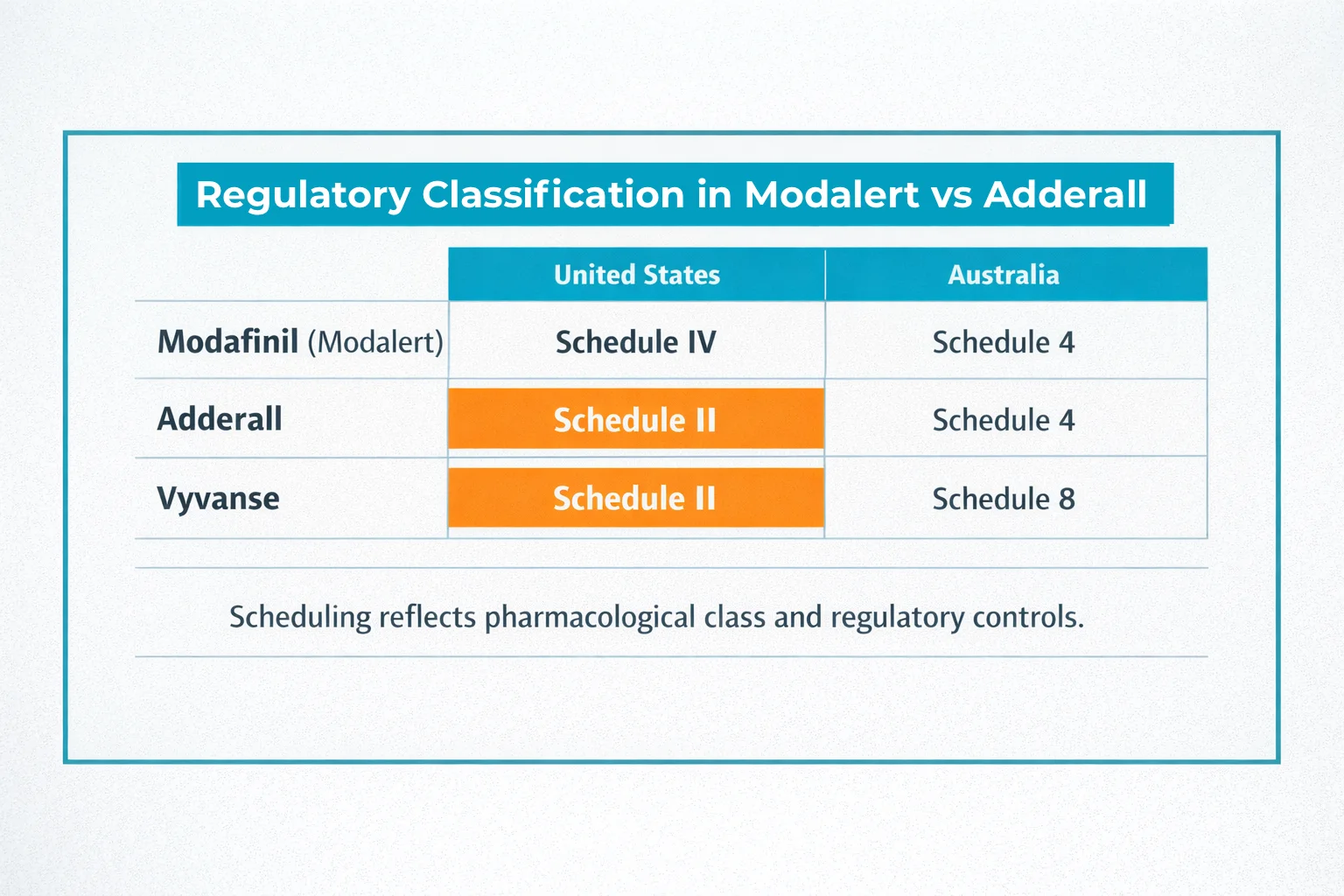
This article presents an educational modalert vs adderall comparison and does not provide medical advice. Modalert (modafinil), Adderall (mixed amphetamine salts), and Vyvanse (lisdexamfetamine) require a prescription in the United States and Australia. U.S. regulators classify Adderall and Vyvanse as Schedule II controlled substances, while they classify modafinil as Schedule IV.
Because these medications differ in mechanism, safety profile, and regulatory status, a licensed healthcare professional should guide treatment decisions. Individuals should also follow applicable local laws.
Introduction to Modalert vs Adderall Comparison
Interest in modalert vs adderall has increased across the United States and Australia. Although discussions often group these medications together, they belong to different pharmacological classes.
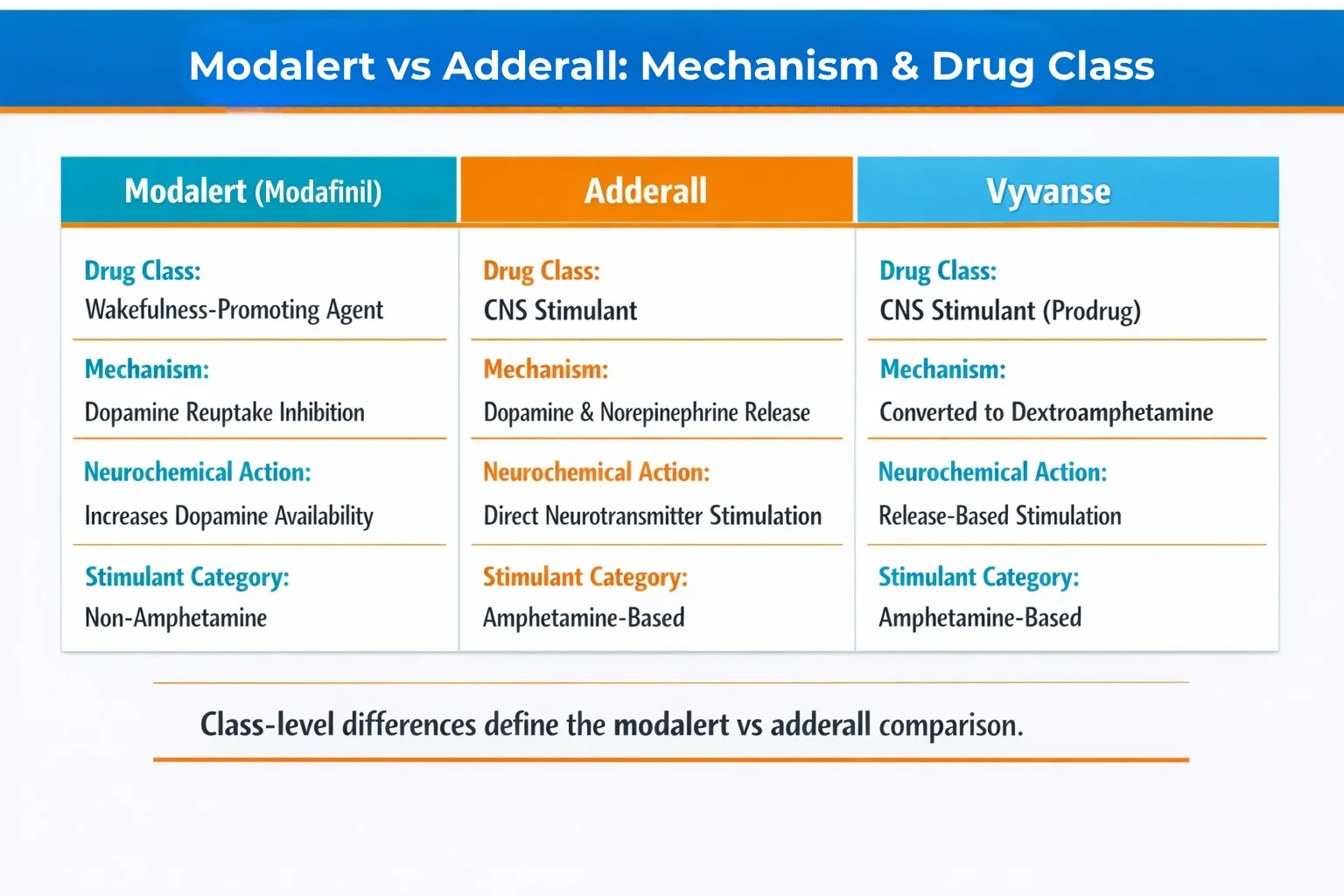
Modalert contains modafinil, which experts define as a wakefulness-promoting agent. In contrast, Adderall and Vyvanse belong to the central nervous system (CNS) stimulant class and contain amphetamine-based compounds. Therefore, the modalert vs adderall discussion focuses on a wakefulness agent versus stimulant distinction rather than a simple brand comparison.
Readers who want broader background can review
Modalert (Modafinil): Uses, Safety, Legality & Buying Guide for foundational context.
Importantly, this article does not claim superiority for any medication. Instead, it explains structural differences, mechanisms of action, pharmacokinetics, and regulatory frameworks. As a result, readers can evaluate the modalert vs adderall topic with stronger scientific clarity.
What Is Modalert in the Modalert vs Adderall Discussion?
Modalert is a branded formulation of modafinil, first approved in the United States in 1998. Unlike traditional stimulants, modafinil does not belong to the amphetamine class. Chemically, it contains R- and S-enantiomers, which distinguish it from mixed amphetamine salts.
Modafinil blocks the dopamine transporter. As a result, dopamine remains active longer in specific brain regions. However, it does not directly trigger dopamine release like amphetamines do. In addition, research suggests involvement of orexin pathways that regulate wakefulness.
Readers can review the
DailyMed modafinil label for official prescribing details.
From a regulatory perspective, the
DEA Drug Scheduling Overview explains why authorities place modafinil in Schedule IV. In contrast, regulators apply stricter controls to Schedule II stimulant medications.
Similarly, Australian authorities classify modafinil under Schedule 4, as outlined in the
TGA scheduling reference.
For cross-country clarification, readers can consult
Is Modalert Legal? UK, US & Australia Regulations Explained.
Within the broader modalert vs adderall comparison, modafinil clearly represents the non-amphetamine wakefulness-promoting category.
What Is Adderall in the Modalert vs Adderall Comparison?
Adderall contains mixed amphetamine salts, including dextroamphetamine and levoamphetamine. Clinicians classify it as a central nervous system stimulant.
Unlike modafinil, amphetamines actively stimulate dopamine and norepinephrine release from presynaptic neurons. Moreover, they reduce reuptake. Consequently, this dual action produces broader nervous system activation.
The United States classifies Adderall as Schedule II due to recognized medical use alongside higher misuse potential. Australia similarly categorizes amphetamine stimulants under Schedule 8.
Complete prescribing details appear in the
DailyMed Adderall label.
Therefore, in the context of modalert vs adderall, the release-based stimulant mechanism forms the key pharmacological distinction.
Where Does Vyvanse Fit in Modalert vs Adderall?
Vyvanse contains lisdexamfetamine, which functions as a prodrug. After ingestion, the body converts it into dextroamphetamine.
Because this conversion occurs metabolically, Vyvanse differs structurally at administration. However, its final effect involves amphetamine-based neurotransmitter release. Therefore, Vyvanse and Adderall share the same stimulant classification.
Readers can review official labeling in the
DailyMed Vyvanse label.
For narrower comparisons, readers may explore
Modafinil vs Vyvanse
and
Armodafinil vs Adderall.
These resources provide additional structural context within the larger modalert vs adderall framework.
Pharmacological Differences in Modalert vs Adderall
When analyzing modalert vs adderall, drug class remains the defining factor.
Wakefulness-Promoting Agent (Modafinil)
Modafinil increases wakefulness by blocking dopamine reuptake. As a result, dopamine signaling lasts longer. Additionally, researchers note possible effects on orexin and histamine systems.
This mechanism differs clearly from amphetamine stimulants.
Amphetamine-Based Stimulants
Adderall and Vyvanse:
- Trigger dopamine and norepinephrine release
- Reverse monoamine transporters
- Reduce neurotransmitter reuptake
Consequently, stimulants create broader central activation.
Therefore, the modalert vs adderall comparison reflects distinct neurochemical pathways rather than minor formulation differences.
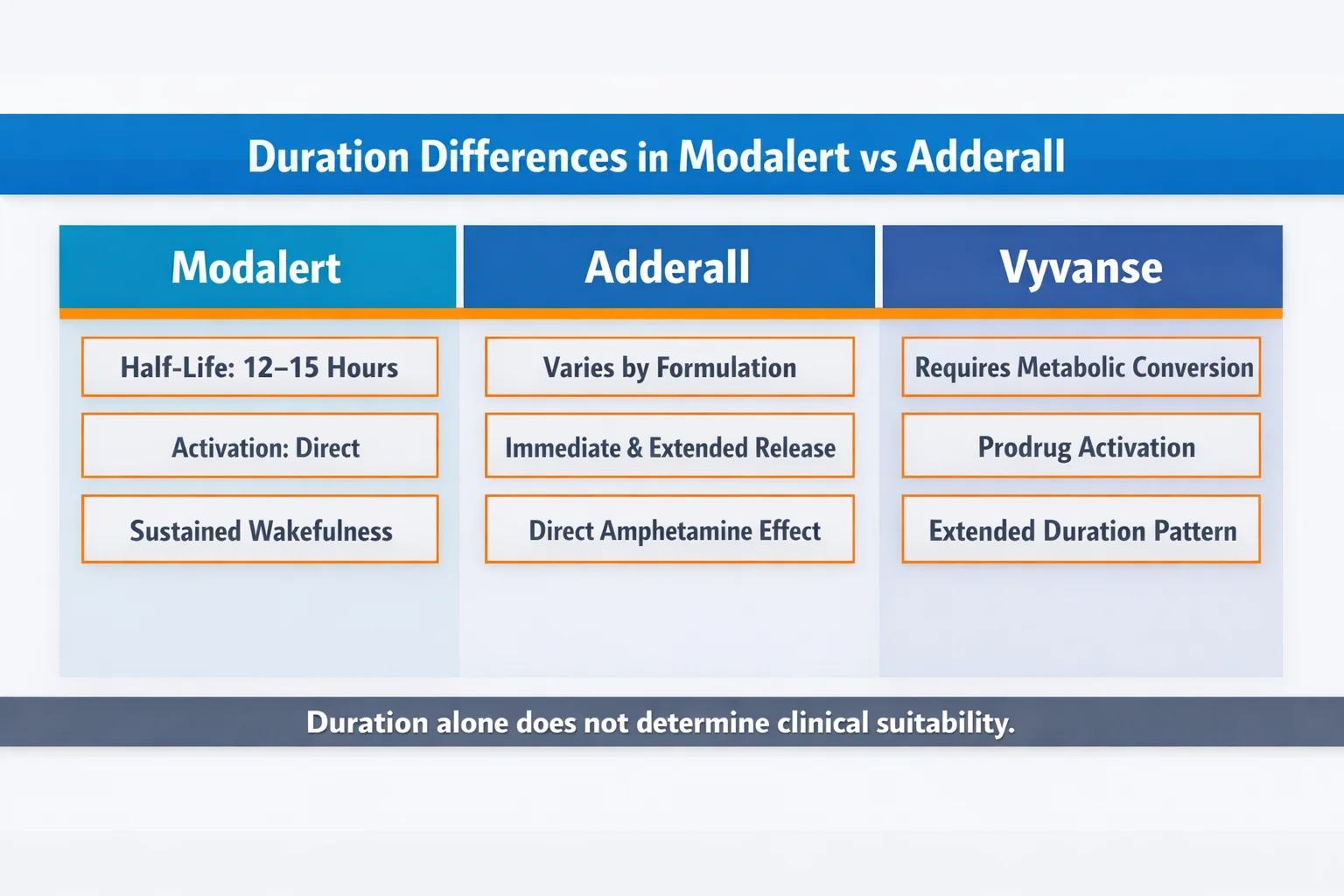
Duration Differences in Modalert vs Adderall
Pharmacokinetics further shape the modalert and adderall discussion.
Modafinil typically shows a half-life of about 12–15 hours. In contrast, Adderall’s duration varies by formulation. Meanwhile, Vyvanse requires metabolic activation before exerting its effect.
Although extended-release stimulants modify absorption timing, they do not change core mechanism. Therefore, duration alone does not determine clinical suitability.
Healthcare professionals evaluate diagnosis, medical history, and individual risk factors. As a result, pharmacokinetic differences provide context but do not define treatment decisions.
Regulatory Classification in Modalert vs Adderall
Regulatory status reinforces class-level distinctions in modalert vs adderall.
Schedule II substances carry stricter prescribing controls due to amphetamine structure and misuse risk. In contrast, Schedule IV substances remain controlled but involve comparatively lower restriction.
Safety and Oversight in Modalert vs Adderall
Both medication categories require medical supervision.
Stimulant Considerations
- Cardiovascular monitoring
- Blood pressure and heart rate assessment
- Psychiatric history screening
- Misuse risk evaluation
Modafinil Considerations
- Headache and insomnia noted in labeling
- Rare dermatologic reactions
- Psychiatric symptom monitoring
Readers seeking additional detail can consult the
Modalert Side Effects guide.
Accordingly, any modalert vs adderall evaluation should occur under physician oversight.
Key Takeaways
- Modalert contains modafinil, a wakefulness-promoting agent.
- Adderall and Vyvanse are amphetamine-based CNS stimulants.
- Modafinil blocks dopamine reuptake, while amphetamines stimulate dopamine release.
- Regulatory classification differs between Schedule IV and Schedule II substances.
- The modalert vs adderall comparison reflects class-level differences rather than brand superiority.
Frequently Asked Questions (Modalert side effects)
No. Modalert contains modafinil, which functions as a wakefulness-promoting agent rather than an amphetamine stimulant.
Authorities place amphetamine-based medications in Schedule II due to structure and misuse potential, whereas they place modafinil in Schedule IV.
The main difference in modalert vs adderall involves mechanism and drug class. Modafinil blocks dopamine reuptake, while Adderall stimulates dopamine and norepinephrine release.
Vyvanse converts into dextroamphetamine in the body. Therefore, both ultimately act through amphetamine-based neurotransmitter release.
Conclusion
The modalert vs adderall discussion centers on pharmacological class differences. Modalert acts as a wakefulness-promoting agent, while Adderall and Vyvanse act as amphetamine-based stimulants.
Regulatory scheduling reflects these distinctions in both the United States and Australia. Ultimately, healthcare professionals determine suitability based on diagnosis and individualized assessment.
For technical reference information, readers may review the Modalert 200mg product page.
Author Note
Greg Nicholl is the CEO and Lead Researcher at Modalerts.com with over 20 years of experience in the pharmaceutical and medical supply sectors. He holds a Master’s Degree in Urology and focuses on regulatory analysis and clinical pharmacology.
His work emphasizes medical neutrality and evidence-based comparisons grounded in peer-reviewed research and official health agency guidance.